Showing posts with label Economics. Show all posts

Tuesday, July 24, 2012

A View to the Future of U.S. Pencil Manufacturing


My last post addressed recent news regarding allegations of illegally imported Chinese pencils.  In order to avoid anti-dumping duties these pencils were apparently transshipped via third party countries such as Taiwan, Vietnam and Indonesia and mislabeled as to country of origin.  Today I am addressing the overall U.S. market for pencils and future of U.S. production of pencils relative to how I see this topic coupled with other developing industry trends.

In my view, regardless of the final outcome of this particular legal case I believe this is a positive development for U.S. pencil manufacturers and other established pencil industry participants who are committed to making quality products and playing by the rules when it comes to all manner of international trade, environmental, labor and product safety regulations.  For the past 20 years the trends of globalization, retail channel consolidation and other competitive market forces have contributed to a dramatic shift in our industry structure just as in many other industries.  As a free market thinker I do not believe these are inherently bad trends and they have led to a number of benefits for society as a whole though those benefits may not always be evenly dispersed and has not always resulted in comparable product quality. 
When it comes to pencils, both here in the U.S. and worldwide, we are seeing more pencils sold and consumed at lower average prices than 20 years ago.  Despite the common misconception that pencils are a dying business, pencil consumption generally grows globally at or around the rate of population growth.  Also per capita pencil consumption tends to increase with income growth as well.  Providing we continue our positive immigration trends we should see stable and slowly growing demand for wood-cased pencils over the long term.  Obviously income growth and dispersion is a current concern in light of recent economic developments, but ultimately I still remain optimistic about U.S. potential from the macroeconomic stand point.

The rise of computers, tablets, or smart phones over this period have yet to prove to me that these technologies are going to displace writing instruments and pencils as a whole.  Technology certainly can impact how and where we use pencils at the margins. However, there is a strong emotional and tactile connection people have with their preferred writing tools and the physical act of depositing graphite, ink, paint or color pigments onto paper.  What could impact per capita pencil consumption even more than technology is allowing another generation of kids to be raised without access to and experiencing the use of good quality pencils. This could drive consumption patterns to alternate writing instruments in the long term.  Despite the benefit of ever cheaper wood-cased pencils on household budgets over the past 20 years , one negative byproduct has been exposing children, teachers and other consumers to a general reduction in the quality of the average pencil sold here in the U.S.  At Pencils.com one of our most common consumer questions is: “Where can I find a decent pencil at a reasonable price in which the lead won’t break, the eraser works without smearing and that actually writes well?”  Teachers often report that the simple act of more frequent breakage and sharpening has become a disruption in the classroom.

One complicating factor is the poor state of funding for education in the U.S., especially when it comes to the provision of basic school supplies. As a result the burden of supplying pencils and other suppliesis increasingly pushed onto teachers and families who have their own budgetconcerns.  The drive for ever lower prices has helped, but has also compromised quality and selection.  As a result the assortment of pencils on retailers’ shelves has declined and the mix increased towards imported private label or low price non-manufacturer brands.  Lower space allocation is offered to traditional quality manufacturer brands.
So what do a bunch of economic, social and demographic trends have to do with an illegal transshipment case and whether this helps the U.S. industry or not.  The question lies in part whether the retailers as a group, begin to see that price of pencils cannot be their sole determining factor in the product mix as there are other costs such as the associated anti-dumping duties and penalties.  Also will consumers take a greater interest in the quality and origins of their pencil purchases?  Sure they are still going to want the best price possible.  However, I tend to think that a supplier who is willing to illegally transship pencils is also a supplier who is more likely to cut corners in product safety and quality.. These are all problems the retailers and consumers don’t want to deal with over the long term.  If retailers increasingly find they will be held responsible for penalties, fines and consumer dissatisfaction as a result of the potential negative aspects of their product supply chain then they are going to increase their diligence in vetting and selecting their suppliers.  Certainly they cannot be expert in every product range they sell and as they are importing many products globally, the headache of assuring compliance on products with anti-dumping duties and other safety or regulatory concerns may result in some level of return for advice and supply to known domestic vendors for improved reliability.  This does not necessarily mean an imported pencil will be replaced by a domestically produced one, but the opportunity for engagement on that supply decision will certainly improve for the U.S. producers.

Further there are currently added economic trends that point towards some return to U.S. manufacturing in general.  My belief is this ultimately will have some positive benefits for the U.S. pencil industry also.  Labor costs in China are now increasing dramatically and though still quite low relative to the U.S. are making it difficult for many general manufacturing companies to find and retain qualified employees.  Chinese labor regulations as well as other environmental and bureaucratic regulations are beginning to impact the general cost of doing business in China.  This first impacts those producers in China who play by the rules, but in time the effects should spread further throughout the Chinese economy. Meanwhile, U.S. domestic energy costs are declining with the increase in domestic gas exploration and development.  Long lead times on overseas supply chains complicate planning and inventory investment while domestic producers can often be more flexible with quicker response times. 
Another important concern within the pencil industry is that Chinese basswood and other Chinese woods have come under pressure for use in other domestic purposes.  More wood is coming from Russia which has less stringent regulatory oversight causing more concern with legal wood supply issues.  A resurgence in total Chinese GDP growth from their current slowdown will have further inflationary impact on global wood supply and thus eventually pencil prices as well.  In my personal assessment we’ve seen a low point reached in global wholesale pencil prices that was reached about two or three years ago.  There will always be some other part of the world, the next low cost country, to move on to, but adequate quality wood supply and transportation costs also have an important impact on pencil economics beyond labor costs and regulatory environments.  Overtime, the developing world catches up in relative costs so the U.S. should be able to adapt and innovate to remain competitive.  That is as long as we do not let our current political stagnation and increasingly burdensome regulatory environment overwhelm us over the long term. As the U.S. remains one of the most important global growers of trees this ultimately will have some positive impact on a host of products manufactured from solid wood.  As a result I do predict that we will eventually see at least some small improvement in U.S. production of pencils and other wooden products over time.

In our own business at California Cedar Products Company we are certainly not prepared to return our slat manufacturing operations to the U.S.  However, we are increasing our commitment to U.S. based wood supply with the recent introduction of our Pacific Albus product range.  Eventually we expect this will be an increasingly relevant component of our business displacing Chinese and Russian Basswood and supplementing our premium California Incense-cedar product range. 
Additionally, we have recently made several small movements towards U.S. production regarding our Palomino Brands pencil ranges.  Recently we relocated the final eraser tipping process for our Palomino Blackwing and Blackwing 602 pencils from Japan to our Stockton, CA using a newly developed tipping process.  This should improve tipping quality and responsiveness as demand for Blackwing pencils grows.  Thought the pencils themselves will continue to be produced in Japan.  Also, we are transitioning our Prospector and Golden Bear products from Thailand production to the U.S. where we are working with one of our slat customers Musgrave Pencil Company to produce these items. The new “made in the USA” versions of both pencils will phase out our prior California Republic versions and be available exclusively on Pencils.com in the coming weeks.  These pencil items represent only a very minute segment of the U.S. pencil market, but do expand our commitment to offering a “Made in the U.S.A.” product selection in our Pencils.com store.

Wednesday, July 11, 2012

Allegations of Illegal Chinese Pencils

U.S. Pencil Anti-Dumping Duties are news once again as a result of new developments with regards to alleged transshipments of pencils produced in China via third countries to avoid these duties.   Despite the imposition of such duties since 1994 there has been a steady increase in imports by retailers and wholesalers most importantly from China, but also Indonesia, and numerous other countries over the past 20 years.  To maintain competitive through out this period much of the traditional volume supplied by U.S. pencil manufacurers has migrated primarily to Mexico and Asia, particularly the largest U.S. producers.

In effect, the large retailers and a new class of importers and distributors have significant increased importance to overall US pencil supply using lower cost imports by bypassing the historical U.S. producers. Today U.S. manufacturers now use a combination of U.S. production, foreign production in their own subsidiary facilities as well as outsourced production from third party foreign suppliers to meet thier customers needs. Only a very few maintain all their production within the U.S.

Today I estimate that less than 10% of U.S. pencil consumption consists of pencils actually manufactured in the United States.  Certainly the actual market share of the traditional U.S. producers is much higher when factoring in production imported from their own facilities in Mexico or China plus what they import from other foreign producers.  Perhaps 50% of the U.S. market today are pencils imported directly from China, despite the anti-dumping duties of 114% levied on Chinese pencils since 1994.  Most of these direct Chinese imports do not pay the full anti-dumping duty given that provisions under the statutes allow for a review process with the U.S. Commerce department that results in reductions in these duties applicable to some Chinese producers/exporters.  However, the review process is expensive and only the largest Chinese producers that export to the US participate.  As a result it has been long suspected that there also have been a substantial number of Chinese produced pencils being illegally transshipped via third countries to avoid these duties.  Suspecting and proving such transshipments however are separate matters. 

Now for the first time since implementation of the duties it was made public in May that there is an active civil case proceeding against several large U.S. retailers and importers for participating in the importation of illegal transshipped Chinese pencils via countries such as Taiwan, Indonesia and Vietnam.  This case was filed in 2008 by the Cullen Law Firm in Washington, D.C. per the this press release published May 17, 2012.  The public docket was made available May 1st.  Note that at this time these remain only allegations, but if the case prevails there are substantive fines and penalties that would be accruing going back to at least 2006 as it’s not just the transshipment to avoid duties that is a potential violation, but also incorrect marking relative to country of origin laws as well. 

I have now had the opportunity to review the actual Docket Report from the U.S. District court which was formally unsealed on May 1st of this year.  Certainly the details of the allegations in these documents seem well researched and argued and are consistent with rumors of various transshipment practices I’ve heard throughout the years.  The Cullen law firm seems confident in their press release.  In the event the case is successful it appears that the the Cullen firm and their client will benefit financially receiving a share of the duties and penalties collected with the balance returning to the U.S. Government which remains an interested party to this case. 
There is also the matter of whether the defendants were knowingly or unknowingly participating in this practice.  My understanding is that the burden of proof on that point is not as relevant in a civil case vs. a criminal case and that may be the rub.  The plaintiff just has to prove the illegal transshipments occurred.  Whether these companies knew they were illegal transshipments doesn’t really matter.  If proven true, clearly the drive for ever lower procurement costs from these retailers will have played a part in supporting the illegal behavior facilitated by thier suppliers in one way or another.  As the importers of record they are potentially subject to the back duties and penalties and as these appear to be rather substantial I assume this case has definitely got their attention and hopefully the attention of other pencil importers.

Finally, from what I’ve learned about the case to date none of the traditional U.S. pencil producers appears to be actively involved as a plaintiff, nor has any been named or identified as a participant in any of the alleged transshipment activities.  In my experience the U.S. Industry participants have always supported “playing by the rules” and indeed several companies were involved as plaintiffs in the original anti-dumping case.  In that respect they helped set the current rules.  Even if some  of these U.S. producers may have relocated much of their own production overseas, they have long been active in assuring that their own imports of finished goods and raw materials are fully compliant with applicable U.S. trade law as well as all relevant consumer products safety regulations, etc.  While the U.S. Writing Instrument Manufacturers Association and it’s Pencil Section have taken no public position on this case, my personal view is that these member companies (of which ours is one) are watching this case with interest and hope that whatever the final ruling it will have some form of positive impact for all of those companies in our industry, foreign or domestic, that play by the rules.
So what does this all mean for U.S. pencil manufacturing?  If proven true, what changes will these defendants and potentially other retailers and importers make in their practices and supply chain structures to address potential risks brought to light by this alleged activity.  Will it benefit U.S. manufacturing or just redistribute purchasing to other foreign manufacturers?  What other market forces are currently at play that could impact the trends regarding the future of U.S. pencil manufacturing?  I’ll address these questions in my next post in just about two weeks time. In the meantime here's a link to a collection of my past posts on international trade issues related to the pencil Industry.

Friday, October 28, 2011

Guitars, Pencils and Lacey Act Compliance

This photo is of my father back in the 1970s during a visit to Kitaboshi Pencil Company in Tokyo, Japan, where I actually visited today. He is being presented a guitar produced using California Incense-cedar by a member of the Sugitani family who are customers using our pencil slats for their products. This gentleman is now retired, but I happened to see him today, he says he still plays guitar every day and had that guitar specially commissioned for my father as a gift. Look for my upcoming post about the history of Kitaboshi Pencil and their products that we will begin selling on Pencils.com next week. California Incense-cedar used in our pencil slats, our customers’ pencils using our slats (and in this one of a kind guitar) is fully compliant with the US Lacey Act which is the main subject of this post.


The recent news of the US Fish & Wildlife Service raid and seizure of Rosewood and Ebony wood raw materials as well as guitars from Gibson Guitars and subsequent claims by Gibson's CEO that the US government is over reaching in its actions has an interesting relevance to challenges also faced by our company and our customers in the U.S. pencil industry. Here are links to three articles about the Gibson issue over the past month:

At issue is the application of the 2008 Amendment to the Lacey Act, a law originally established in 1900 governing the illegal trafficking of hunted wildlife and game across state lines and since inception has continually expanded in scope and breadth to cover fish and plants. The law is administered by the Animal and Plant Health Inspection Service (APHIS) within the U.S. Department of Agriculture and jointly enforced with U.S. Department of Fish & Game which is the lead agency in the case against Gibson Guitars.

Under the 2008 amendment the law was extended to plants, wood and products made from wood and plant materials. The amendment requires importers of applicable products to certify that the wood materials used in their products were not obtained from illegally harvested materials or include any protected or threatened tree species. The amendment implemented a number of documentation and declaration requirements that must now accompany each import shipment with respect to specific species used, country of origin of the trees from which the wood product was produced and statements relative to the legal harvesting of the trees used in the. Knowingly importing wood or wooden products covered by the law is a violation of the law subject to both civil and criminal penalties. Heralded as an improvement in environmental policy the amendment was also supported by the Bush Administration as a protectionist measure for the US timber and wood products industry against lower cost imported woods.

While I have no specific knowledge of and cannot speak to the specific issues involved with Gibson's case I can certainly state that illogical and inconsistent application of the rules process by government agencies responsible for enforcing the Lacey Act is a ripe example of the "law of unintended consequences" as with much government regulation. CalCedar has been deeply involved in addressing the 2008 Lacey Act amendment relative to compliance of our own pencil wood supply as well as understanding the impacts of the law on our company, our customers and the pencil industry supply chain as a whole.

We have long taken an industry leadership position in assuring the wood resources we utilize are harvested from well managed forests according to applicable rules and regulations in any countries we source our wood from. We have and continue to support industry efforts to increase the overall sustainability and have been a pioneer in implementing FSC and SFI third party certification to an increasing proportion of our wood supply. Thus in concept implementation of the Lacey Act amendments in 2008 was a step in a positive direction with a goal of eliminating illegally sourced raw material or utilization of any threatened plant species. Though the standards applied as to what’s illegal or legal or threatened or not can vary from country to country as the Lacey Act simply requires compliance to the applicable laws in the country of harvest. Thus the level of added environmental protection here is inconsistent from country to country.

The Lacey Act requirements added a whole new level of documentation and due diligence required for us to supply slats to our US based pencil manufacturing customers. This included updated investigations and documentation of our wood supply chain and added costs of consulting in the investigation with an accredited third party certification agency as to appropriate precautions including the added burden to segregate and/or eliminate any wood of potential concern and to maintain clear chain of custody of all our through the supply chain. All of this was already occurring with respect to our FSC and SFI material in both Cedar and Basswood, but we felt it important to apply these processes to the balance of our Basswood supply chain. Where we could not clearly document exact origin we sorted out the material to create yet another classification of inventory. Thus with respect to our Basswood pencil slats we now must keep separate inventory and track three different groups of products; FSC certified, Lacey Compliant and standard inventory which we do not believe is a compliance concern but will not take the risk of selling into the US market without clear chain of custody back to the forest.

However, this burden of declaration documentation was not extended to the importers of pencils themselves. Thus wood sold to our customers who produce pencils in the US is subject to the documentation requirements while finished imported pencils are not, placing an added burden on U.S. pencil producers. Given that the majority of pencils consumed in the U.S. today and before the amendment took effect were imported this inconsistent application of the statute to intermediate vs. finished products hardly serves to protect US manufacturing jobs or to ensure that the majority of pencils sold in the US are indeed Lacey Act compliant. This does not mean many or even most pencils are not compliant, just that the chances are higher that they could be. As far as musical instruments are concerned importation of pianos and stringed musical instruments, including guitars, seem to have become subject to the documentation and declaration requirements in April 2010, so in this case it appears the compliance playing field may be a bit more level between US and Foreign producers in that industry.

Next, the rules are not very specific on the level of sufficient due diligence to protect an importer from prosecution and civil and criminal penalties under the act. The "due care" principal is used which is generally contextually applied depending upon the level of organizational expertise and level of involvement in the supply chain of the importer of record. Thus as an experienced wood products manufacturer standards for "due care" applied to our company may be interpreted by the relevant agency differently than that of an importer of finished pencils who tends to rely solely upon the level of documentation they choose to request from their supplier. In many cases such suppliers are simply foreign trading companies, not manufacturers themselves, relying on the say so of their own supplier. With much pressure put on the price of imported pencils and other wood products this provides some level of incentive to less ethical suppliers to fudge in the information provided to their U.S. import customer. If a U.S. importer does not perform an on the ground investigation or use a knowledgeable third party certification agency, which is not specifically required under the statute, and simply relies on the paperwork provided by their supplier, they may be at some elevated risk of exposure to prosecution as to whether they employed “due care” in the event there is ultimately some problem found with the legality of the raw materials. This essentially becomes a risk management exercise for each importer with differing levels of risk tolerance and exposure.

Finally, as a knowledgeable U.S. company operating our own facility in China and selling globally we are more at risk of punishment under this U.S. act than are our foreign competitors. It’s going to be difficult for a U.S. importer penalized under the act to recoup any fines even if they have some form of guarantee. As such we've taken a more conservative approach to managing this issue in our company. This is also more costly than most of our foreign competitors especially those who are exporting finished pencils to the US where no specific requirements for their U.S. import customers to file the import declarations. This does not mean those pencils are not subject to requirement to be legally harvested, but they have less risk of being challenged as to compliance.

As a company we are continually working to insure that an increasing portion of our wood supply to the pencil industry actually is part of one or more accepted third party certification programs, most specifically FSC or SFI, under the PEFC umbrella. Given both inflationary cost and supply developments with respect to Basswood in China resulting from the Chinese government now enforcing greater harvest restrictions we are currently testing and introducing a new 100% FSC certified product line named Pacific Albus. This new product is U.S. plantation grown and fully Lacey Act compliant. We see Pacific Albus becoming increasingly important versus Chinese or Russian grown Basswood in our company’s supply program and is a product that will be proprietary to our company. I expect to post more about this new product range as we move forward with greater adoption and acceptance into the industry by our customers.

Tuesday, October 25, 2011

Celebrating the Japanese Pencil Industry

Sometime next week, tentatively on November 2nd, we’ll be introducing a few select items from two Japanese brands on Pencils.com; Kitaboshi Pencil Company and Tombow. The selection includes several great items for the holiday gift giving season. You can learn more about those specific items in an upcoming Studio 602 story early next week.

This expansion of brands at Pencils.com is a part of our continuing effort to introduce more of the products of our pencil slat customers’ from around the world. This allows us to increase the breadth of great high quality pencil offerings on Pencils.com, some of which are not readily available or well known in the U.S. Market. It also helps increase awareness and appreciation of some great pencils and of the wood-cased pencil in general. Given our close relations as a wood slat supplier to many producers around the world, we hope to continue growing our offering mix quite a bit over the next year.

This week also marks my annual visit to Tokyo to visit a number of our pencil slat customers and to work with our Palomino and Blackwing producer about production planning and product development for new pencil items we expect to introduce in 2012. Most notably a Palomino quality, private label pencil program, though we’ll share more about this in the coming months as that program moves closer to launch.

The Japanese Pencil industry is probably one of the most interesting domestic pencil industries in the world. Relatively young by comparison to its European and US counterparts with several brands dating back 100+ years, most Japanese production and development of wood-cased pencils began in the post World War II era. Over the past 20 years the industry has been subject to many of the globalization pressures faced by other developed western markets it also faces an extra challenge of demographic trends; a declining and aging population which means the consumption of pencils in Japan is actually declining year to year and has been for some time. Japan is the highest cost pencil production market in the world which is reflected in their prices. As a result very little exportation of Japanese wood-cased pencils is occurring, so the local market dictates overall production trends domestically. (In fact Pencils.com with our Palomino and Blackwing products and more Japanese pencils coming may be one of the largest volume export distributors to North America already.)

Despite these trends the Japanese production supply chain remains relatively intact and traditional without the degree of radical makeovers of mergers, acquisitions, or the extent of off-shoring production that the industry has witnessed in North America and Europe. Yes, there are certainly fewer producers over time, with several dropping out over the pat few years, but the basic structure has been relatively static. Also taken in context of relative market size vs. Europe and North America there are actually proportionately more Japanese companies actively involved in the production of pencils and pencil components in Japan today than in these other regions.

Why is this? Several factors contribute.

First, Japan is a high quality and brand loyal market with consumers who understand the difference between good and bad pencils and are willing to pay the difference. The 100 yen pencil is quite common and Beyond the major brands, Mitsubishi with its Hi-Uni and Tombow with it’s Mono, there has long been a unique demand for specialty pencils that also give a collectibles status such as “Character Pencils”, popular Disney, Pokemon and Anime characters licensed to either a pencil producer or a marketing company that contracts a local producer to produce their pencils. “Game Pencils” which treat the 6 sides of the pencil as a sort of die which children can roll against one another and win each other’s pencils. And a whole range of designer theme pencils. Such innovations were first made popular in the Japan before being adopted by some US companies focusing on the school pencil market as they attempted. Even if a marketing company has the rights to a character they most generally still use a Japanese sub-contractor for quality reasons and there have been a few lessons learned about the expectations of the Japanese consumer when the quality of an imported character pencil was not up to par. In the US, more and more of such license or designer theme pencils are imported by marketers from lower cost manufacturing, with just a couple companies actively producing such pencils in the US today. In Japan all the companies are involved in this segment of the market.

Second, the unique structure of the Japanese industry involves a variety of specialist subcontractors, some who only specialize in one or two parts of the manufacturing process, such as wood-working, lacquering and finishing, graphite & color core production or packaging. Larger companies such as Mitsubishi and Tombow and mid tier producers such as Sakamoto and Kitaboshi use these often more nimble or uniquely skilled sub-contractors to meet special processing needs, smaller production run sizes and do quicker turnaround on orders. The character pencil marketing companies as well as some branded pens producers such as Pentel rely entirely on sub-contractors for their wood cased pencil needs. Such a structure helps to shorten the supply chain vs. imported pencils in the changing specialty, novelty pencil market.

All of these sub-contractors are small family owned companies operating essentially in a building that co-locates production with their own homes. They are more like traditional artisan workshops than what the average person would picture as a factory. The owners of these businesses are highly skilled and knowledgeable about their business. The extreme care and detail they speak with in discussing the technical aspects of doing this or that operation in the manufacturing process can be a truly amazing experience. Generally their home and factory debt has long been paid off and though their equipment is old and slow they are the best at what they do.

Still this industry structure faces several threats which are a factor of both the demographic and competitive globalization trends over time. As the overall market shrinks and largest producers feel pressure from lower cost pencils they tend to keep more production in house to retain their economies of scale, thus slowly squeezing some of the subcontractors out. Mainly, focused on non-pencil products such as pens, markers, correction tape, etc. these companies still feel their pencil business is important and need remain the most efficient volume producers. Some have set up off-shore production of certain pencil components or assembly operations for some products in Vietnam or China, similar to western producers who have gone multi-national in their operations. Over time the mid-tier companies have adapted by focusing on introducing new products to diversify their business away from pencils into complementary novelty items, by broadening their sales distribution channels or dropping certain manufacturing functions to use subcontractors, etc. Finally, as the business owners’ age in the sub-contractor segment, often the 2nd or 3rd generation family members are not interested in continuing with the same passion as their parents, so these businesses also tend to shake out due to lack of management succession or natural selection of a sort.

As a wood supplier to the Japanese Pencil Industry for three generations, our company is always conscious of these challenges. We value the close relationships we’ve built with many of these companies and families and salute their commitment to producing the highest quality wood-cased pencils. Adding and promoting more pencils produced in Japan to our Pencils.com offerings is just one small way of supporting these friends in the industry. They produce some of the most unique and interesting novelty pencils in the world and in time we hope to make this collectable segment a larger part of our offering in addition to some of the branded items we’ll be introducing in the coming weeks and months. We hope you’ll help you’ll join us in our Japanese Pencil Celebration event in November at Pencils.com.

Wednesday, June 29, 2011

Chinese Pencil Anti-Dumping Duties Revisted

Bloomberg.com published an article on June 27th covering the pencil industry titled "New Jersey Pencil Maker Cedes No. 2's to China". While the title refers specifically to General Pencil Company and quotes it's owner and CEO Jim Weissenborn, the article has a broader focus on U.S. Anti-Dumping as it applies to the pencil industry as a whole. Anti-dumping duties and the Chinese pencil industry is a topic I've commented on in past posts over the years: Pencil Anti Dumping Duties: Primer and Pencil Anti Dumping Duties: Changes in the Air.

The article was prompted by the June 13th decision by the U.S. Trade Commission to extend for another 5 years the countervailing anti-dumping duties against Chinese pencils. In addition to Weissenborn it includes includes quotes from other industry representatives in support of the duties as well as several economists who claim that such duties do little to protect U.S. producers as production just gets shifted to other low cost countries. The article provides several statistics regarding the U.S. Pencil industry gleaned from the associated filings demonstrating that despite the duties (which have been in place about 15-20 years now) imports of Chinese pencils to the US have increased five fold since 1996 with statements that US producers accounted for just 14% of US pencil sales in 2008.

I agree generally with the statistical trends and the views of the economists that the long term impacts of anti-dumping duties don't necessarily protect U.S. Producers from the challenges of global competition. ONe can always nit-pic specific figures and percentages. The fact is in the end you still have to compete on your own innovation, manufacturing and/or purchasing efficiency and ultimately find your proper niche in the market. A point Jim Weissenborn speaks to well in the article with respect to General's market focus.

However, one aspect that is not addressed in the authors argument is that a large portion of the Chinese pencils coming into the US are in fact not paying significant anti-dumping duties relative to the China wide rate of 114%. This is because there is a process of reviewing and applying for producer specific anti-dumping duty rate adjustments with the Commerce Department. As a result the largest Chinese exporters to the U.S. are only subject to anti-dumping duty rates in the range of 1-5%, not 114%. This rate adjustment review process is an expensive and complicated legal and accounting process that makes sense for only the largest suppliers. This itself introduces further inefficiencies and opportunities for gaming the system to avoid duties, including shipping pencils from other suppliers via the favored duties of these larger entities a challenging issue to police. Eliminating such special rate reduction applications might make the system simpler in total. However, it still does not address the fact that such a change would likely spur an increased wave of trans-shipment of Chinese pencils to the US via other countries, an illegal practice, though challenging to police and administer.

Regardless of such inefficiencies in the system many Pencil industry insiders believe the duties are warranted given the "hidden subsidies" received by Chinese producers. One example is the VAT rebates received from the Chinese government on finished pencils exported from China. These are not applicable to slats and other components exported, thus favoring finished production in China itself. Another form of subsidy has been domestic wood costs that has been artificially low due to over harvesting over many years. In fact we are now seeing that China is experiencing dramatic increases in wood costs for all sorts of industries as the Government is curtailing harvest levels on it's forests through out the country. This is currently driving a cycle of inflationary price increases in raw material, slats and ultimate Chinese pencil prices. A subject I'll be addressing in a future post sometime in the next month, but the point here is that Chinese wood supply has been at relative lower costs than other substitute woods for our industry many years and would have been higher if forests were managed more effectively on a sustained. Fortunately the Chinese now seem to be working to correct this, though this has not dimmed their appetite for wood.

In the end the anti-dumping duties have assisted the US industry from being totally decimated by Chinese imports, even though many US Producers have had to become involved in Chinese production or imported pencil supply themselves to competitively serve some share of their US sales. Small private family owned producers such as General's and Musgrave mentioned in the Bloomberg article remain in existence today in part through the benefit of such protective duties, but just as importantly through their own dedication and commitment to producing and marketing quality products. offering superior customer service and valuing the traditions and knowledge developed through several generations involvement in the industry and the contributions to the communities in which they live. Strictly economic arguments on the subject of the good and evil of protective duties to society rarely address these social benefits.

Friday, September 17, 2010

Reviving the Blackwing: Eraser Performance and Design


Ultimately, as we all now understand the story, the breakdown of the specialized ferrule production equipment and the costs to repair or replace the machine factored in the decision by Newell Rubbermaid (Sanford) to discontinue the Blackwing. The economic return did not seem to cover the cost of restarting production given the limited sales for the product and the company’s primary focus on mass market products. Of course, I also doubt anyone ever expected pencil aficionados would eventually be willing to pay from $20 to $40 each for these pencils down the road either. It’s an interesting speculation to consider if armed with such knowledge what new pricing they might have been sufficient to justify the repair or replacement of the machine and continue the product at that time. Who knows if anyone performed such an analysis or just looked at the unit volume and decided to call it quits?

Bringing back the classic ferrule with its flat rectangular, extendable eraser was a key factor for me in deciding to move forward with the Palomino Blackwing. As some fans have noted the Palomino, Mitsubishi Hi-Uni, Tombow Mono, or Staedtler Lumograph brands each have specific grades that compare rather closely to the original 602 performance. Therefore at least to me, without this classic ferrule and eraser design included there could be no return for the Blackwing brand. Finding a vendor that would agree to reproduce the functional eraser assembly to our desired quality standard while protecting our tooling investment and not allowing reproduction for other pencil manufacturers was important to me. Another key decision factor was to obtain a reasonable economic cost relative to standard tipping, even though it was clearly always going to be much more expensive per pencil than regular erasers. Important considerations became the tooling costs investment to be able to produce the assembly components as well as the appropriate minimum order volumes for a given unit cost. Discussions and investigations on this actually took place over a period of a year or more. We did commit however to the tooling cost early on to produce the ferrule (well over a year ago) just so that we could begin to produce some test samples.

At one point after we had paid for the tooling we we’re told we would have to move our original target minimum order size for our first order from 50,000 as originally quoted to 500,000 pieces if we wanted to keep the price unchanged. This just about killed the whole project and created long delays as we assessed whether to proceed or not, considered alternate options and negotiated further. By the standards of most commodity oriented good quality, high volume cedar pencils (e.g. Ticonderoga or Mirado) selling at or around $0.20 to $0.25 each 500,000 pieces is not a very high production figure at all. However, for a niche, high quality item we expected would ultimately have a retail price point, somewhere between $1.50 to $2.00 per pencil, this could be a significant initial inventory investment just for these assemblies, depending on ultimate acceptance of the product. This also raised concerns such as eraser life if initial sell through was not very good. In the end we were able to settle on an initial production run of 100,000 ferrule/eraser assemblies and this coincides with the number of pencils we are producing in this first run for the Palomino Blackwing.

Feedback on the eraser assembly and performance overall has been positive overall. Several reviewers have noted the exceptional care with which the ferrules and erasers are glued, rather than crimped on to the pencil mechanically, and that the flat side of the ferrule/eraser set is oriented so that the imprint is face up. This is not the case with the original Blackwing which has random application angles. In reality the end of each pencil is actually machined down slightly before attaching the eraser assembly vs. standard eraser tipping which more commonly slightly crushes the wood before attatching and crimping on the ferrule and eraser.


The Palomino Blackwing erasers are about 25% larger in total cubic volume and 15% wider than those of the original, providing improved eraser surface area. They are also produced with improved materials than the natural rubber/pumice composite materials used in the original Blackwing's erasers. Here I’d like to add a technical note as there have been several comments on blogs referring to the Palomino Blackwing’s eraser as a vinyl eraser. This is not the case and is an inaccurate assumption on the part of those individuals. While vinyl based materials did become more prevalent for art and pencil top eraser use as a replacement for traditional natural rubber based composites, vinyl erasers are actually currently in declining use by the industry. Our erasers are produced using Thermoplastic elastomere (TPE). Thus they are more appropriately called polymer erasers vs. vinyl erasers which are produced using PVC material. The change to TPE from PVC was initiated by the industry to eliminate chloride from the production process and finished product. The vinyl erasers that are most commonly used today are larger hand held block eraser formats. Most pencil top erasers from major brand manufacturers and all those we use in our California Republic product ranges are polymer erasers, even if they are other colors such as more traditional red or pink. For an interesting history of the eraser and technical information about the different materials used over time Staedtler has a very useful resource guide, here.

We did get some feedback that with our darker lead mark than the original Blackwing, erasing with our new eraser still leaves a slight trace of a smudge, or "ghosting". This is another issue we are re-evaluating for future production and are now told by our supplier there is an opportunity to improve on this versus the current eraser we are using in the Palomino Blackwing. However, we have not had a chance to evaluate cost differences or do any actual testing. The current eraser is the same quality as that used on our Palomino HB pencils.

Finally, some traditional fans do seem to prefer the old pink eraser color versus the white version which we selected. Others have suggested black would be very nice as well. Color of the eraser specifically is not really a factor in it's performance though it seems to be a common misconception that a white eraser works better than a red or pink eraser. It all comes down to materials. Performance differences with the original Blackwing certainly have something also to do with the age of these older pencils and the effects of oxidation and exposure to light. At this point I cannot indicate if there will be an eraser color change down the road as this is dependent upon what future cosmetic design changes we might implement for the pencil overall as well.

Thursday, September 09, 2010

Reviving the Blackwing: Why take on this Challenge?

In Part One of this Series, I introduced our current process of gathering initial consumer response to our new Palomino Blackwing pencil. While we’re completing our evaluation of responses today I answer the question “Why is CalCedar reviving the Blackwing?”.

Photo Courtesy: The Blackwing Pages

Pure and simple. Blackwing is a great and iconic name among serious pencil fans. Revered for its legendary smooth writing performance and classic extendable rectangular eraser it’s become known as the pencil of famous animators, illustrators, musicians and writers as well as those who simply appreciate the best. The Blackwing’s lore has increased since production was discontinued in 1998, creating an “old stock” eBay market bearing prices from $20 to $40 per pencil. This pencil is kept as a collectable or stingily used only for special creative activities. All other high quality graphite pencils seem to be compared to the Blackwing as the standard of perfection.

Anyone crazy enough to try to build a new brand name in a rough and tumble globalized commodity business like the pencil industry is always going to want the best advantage possible. Very few pencil producers really professionally and effectively advertise and market pencils anymore. The closest promotion the average consumer is exposed to are circular ads of mass retailers and office superstores offering “loss leader” prices during back to school time to get people in the door. They’ll give away $2 of pencils at or below cost to sell that $10 to 20 calculator and other goods that makes them much higher margins. The cost pressure from the large retailers drives producers towards an obsessive focus on the economics of pencil production. Over the last 20 years, this has resulted in a reduction in the general quality of pencils and outsourcing overseas while cutting marketing support dollars and manpower devoted to thinking creatively about pencils.

The benefit to society is a lower cost product on average when it comes to pencils. The cost is a loss of understanding and appreciation by the average pencil user of what a good quality pencil really feels like to use and how it performs. The proof, put a Palomino, a Mitsubishi Hi-Uni, a Tombow Mono or a Blackwing in the hands of the average person and ask them to compare side by side with their normal everyday pencil and watch their response as they write, doodle and explore the fine writing characteristics of these pencils.

Since we launched our California Republic range my vision has been to establish our premium quality Palomino brand as fresh, new and fun, with great quality and safety performance. This has been a gradual and experimental process mostly conducted over the internet and in my spare time when not attending to our core slat and firelog businesses. Nevertheless we are building a small, but growing fan base and our recent Pencils.com website redesign is helping to move this ball forward with our “Freedom of Expression” theme as well as expanded features and products. In our view the pencil is perhaps the most common and affordable tool of creative self-expression used around the world. It may not have the reach of the internet, but there is a personal sense of connection to writing, drawing, sketching or doodling with a pencil that for many cannot be matched by typing on a keyboard or drawing with a stylus on a computer screen. For us, Palomino is an important part of enhancing “freedom of expression”, but we know finding your favorite instrument of self-expression is a personal journey and so in time we’ll be featuring even more pencils from other producers who use our slats in our store. This also helps promote quality wood-cased pencils in general and provides a new and creative means to support our slat customers, something CalCedar has been devoted to for over 80 years. Ultimately, however to make Palomino and our California Republic family of products economically successful brands, an added catalyst is needed to move the ball forward.

Ever since we introduced the Palomino it has regularly been referred to by many Blackwing fans as a principal contender for successor to the original 602. These fans continually lament the ceasing of production of this pencil and the increasingly high cost of “old stock” on eBay. When I discovered the Blackwing name was available it was a natural choice to want to more closely associate this venerable name with our own brand. The goal: Create a Palomino product line extension that honors the performance and functionality of the original Blackwing 602 while building a new and expanding generation of pencil lovers who appreciate fine quality pencils. Who would not want to pursue this opportunity? It’s both tremendously fun and challenging. If we’re right, execute well, and perhaps a little lucky, then maybe we’ll make some modest financial return and turn a passion into a profitable business venture.

Wednesday, September 08, 2010

Nobel Economist Paul Krugman loses to a Pencil

I realize you're probably expecting a new "Revival of the Blackwing" post today, but just saw this and could not resist this bit of pencil related satire from Op-Toons Review. It directly references topics I've covered here in the past from Leonard Read's essay, "I, Pencil".


I particularly loved the line:
"It wasn't fair," Krugman complained after the show. "The pencil represents a vast collection of information that could never result from the orders of government bureaucrats working with economics experts like me. That blasted pencil is the product of a staggeringly sophisticated but spontaneous free enterprise..."
Read the full story here.
Don't worrry fans. Tomorrow you'll get to read why we're bothering with this whole Blackwing Revival thing anyway.

Sunday, November 29, 2009

These Collectors Can't See the Art for the Trees

I've always had an interest in understanding how different economic, business and social principles apply to different industries and markets, particularly with respect to historical development of markets over time. Lately I've been reading more about the economics of the Art market leading me to an article by Paco Barragan at ARTPULSE Magazine titled "The New Spirit of Collecting: From Macenas to Prescriptor to Speculator". The article focuses on the historic transition of collecting art from a system of patronage and philanthropic support of the arts through to those who Paco describes as while still maintaining some sense of "the rank of trophy predators" now have set a new trend as "aggressive and benefit-seeking sharks" who's only motivation is to drive up the value of their holdings whatever level of undue influence and market manipulation is required.

He goes on to state that this trend is now pushing it's way into the European collector's psyche:

"Furthermore, the traditional European collector, with an extensive knowledge of art history and a profound respect for artists and art professionals, has given way to a new breed of collector inspired by the "American Model," based upon aggressive price negotiation, quick access to board of trustees of museums n order to conveniently push his artists, and in the end, the attainment of significant economic results for his investment in art."

Barragan appears to be describing a bunch of Wall Street speculators gone wild referring to a the neo-capitalism model of art collecting. Next he'll be calling for government intervention and regulation of the Art Market and as much as implies he would be a supporter of such a concept:

"Obviously there's a "new spirit of collecting," which has come along with the "new spirit of capitalism" ... that, I am afraid, not even Obama will be able to regulate."

As with any free market the excess of a few collectors who perhaps cannot see the Art for the Trees will always push the envelop. In my view the mainstream art collector still acquires based upon personal sense of appreciation for the art and artist on their own merit, not based on some fanatical obsession with profit making. Let's not overreact to the actions of a few and in my view if Barragan thinks the art world has not seen likes of obsessive promoters with good connections to ultimate benefactors and collectors for hundreds of years then he's generally naive.

One of the blessings of all the new social media is it's facilitation of sharing and appreciation of art and interactions among artists, fans and collectors alike. It may not be the most profitable means of getting rich as an artist, bit these media are opening up new windows for artists and becoming more of the mainstream (truly neo-capitalist) means for art distribution over time. Perhaps there will be some commoditization effect that impact valuation, but ultimately a greater number of artists will benefit as a whole vs. those playing in the shark tank who rise and fall as most speculative markets do over time. I think we pencil collectors and other art fans on the web need not worry much about these "aggressive benefit seeking sharks" out there.

Saturday, December 06, 2008

And Then There Were Three??

Recently Newell-Rubbermaid (a.ka. Sanford Brands when it comes to writing instruments) announced the planned closure of it's Lewisburg, TN pencil manufacturing facility. This was part of a general restructuring involving at least 4 of Sanford's US manufacturing facilities in Tennessee including also the towns of Shelbyville, Manchester and Maryville. Thier announcement to suppliers states:

"Manchester will become our global center of excellence for ink manufacturing. We started construction in October on this state-of-the-art facility, which will be the largest writing ink plant in the world."

"We will move manufacturing operations from Shelbyville to Maryville by the end of 2009. Maryville will become the center of manufacturing excellence for markers, highlighters and dry erase products under the Sharpie®, Expo® and other brands. Additionally, we will construct a new specialty packaging facility adjacent to our Shelbyville distribution center. This packaging center of excellence will incorporate best in class packaging processes that will allow us to better meet and exceed customer requirements."

and ...

"We will close our Lewisburg facility by the end of Q3 2009. Production will be moved to other Newell Rubbermaid facilities, including Maryville."

However, it has not been formally announced what their specific plans are for wood-cased pencil manufacturing. There is some speculation all wood cased pencil production will move to other Newell (Sanford) facilities outside of the US, specifically Mexicali, Mexico (graphite) and to Bogota, Columbia where color pencils are now produced for the Latin America market. Perhaps reserving just packaging operations for US facilities. So there is a chance this development would leave the US with just three remaining wood-cased pencil manufacturing facilities serving the traditional writing and art pencil market: General Pencil Co. (Jersey City, NJ) , Musgrave Pencil Co. (Shelbyville, TN) and MegaBrand's RoseMoon facility (formerly RoseArt and Moon Pencil/Products in Lewisburg, TN). Currently Megabrands Stationery and Activity business which includes the RoseMoon facility is on the market so who knows what teh future holds for this facility.

Note that my definitition of wood-cased manufacturers specifically excludes promotional or advertising pencil operations or other "finishing" operations where the milling of the slats into pencil is not performed. There are still a number of these finishers who take either raw or painted blanks and complete assembly, finishing and packaging. My definitition also excludes cosmetic pencil manufacturing of which there is one remaining facility, Cosmolab also located in Lewisburg, TN.

With the shuttering of the Shelbyville & Lewisburg facilities Newell brings down the closing curtain on two more factory sites of historical importance to the US Pencil industry. The Shelbyville facility (located formerly on Pencil St. and now renamed Sharpie Way) was the site of the Empire-Berol facility which resulted from the consolidation of these two companies in the 1980s. Mirado and Prismacolor brands were produced at this facility before relocating to Lewisberg soon after Newell's acquisition of Berol in the mid 1990s. The Lewisburg plant, part of Newells acquisition of Faber-Castell USA (which excluded the Faber-Castell brand name rights) just a year before the Berol purchase, had a long history of swallowing up production of newly acquired pencil competitors regardless of the owner of this facility. An appropriate discussion of the Lewisburg facilities production and brand range history alone would require a separate post though I have posted on this topic before, see Mongolized. Perhaps I'll work on a more thorough history of the Lewisburg facility for a futre post timed with the actual plant closure next year.

Adding the former Empire Pencil plastic extruded pencil facility in Shelbyville this brings to a total of three the number of US pencil factories shuttered by Newell over a 15 year period in the name of building global centers of manufacturing excellence. All the while thier wood/plastic cased pencil prodction in the US has declined by about 2/3 vs total production of those facilities at the time of each acquisition. This has been accompanied by the elimination of a corresponding proportion of pencil brand names. Whether these new centers of excellence in the US will really include wood cased pencil production remains to be seen. Newell and Sanford's slogan these days is "Brands that Matter" and clearly they have been deciding for some time that most of the pencil brands they acquired just don't matter. Other than Prismacolor and now Papermate which both include a whole host of other similarly "umbrella" branded complementary products there has really been no specific marketing support to Sanford's pencil brands here in the USA.

Perhaps all this is simply a natural progression of the pencil industry where there are over 200 pencil factories in China alone battling it out and more and more US and European production is being relocated or outsourced. Pencil industry margins are very thin due to this commodity efffect and Newell's focus is clearly on higher margin businesses. It's clear Lewisburg as a stand alone pencil factory in the US produced a majority of mass market and commodity oriented products that could no longer afford the overhead of this large older and inneficient facility. Perhaps co-locating a smaller wood-cased pencil operation in a modern facility with other products in the Sanford family will result in "excellence" if they do indeed go this route vs. moving off-shore. A stronger long term commitment to creatively marketing and developing new innovative products in wood-cased pencils may have made an impact on this trend. Who knows? Though a comparison to an industry innovator such as Faber-Castell who have indeed made such a commitment does give some clue. Will Sanford now decide their remaining wood-cased pencils products are indeed Brands that Matter?

Monday, November 19, 2007

Support the Writers Pencil Campaign

Tired of watching reruns already on late night talk shows? Worried your weekly favorite shows will soon be headed to reruns?

Our associates at United Hollywood blog have launched a new campaign to promote the cause of the Writers Guild of America and guess what … It involves pencils. Titled “Pencils 2 Media Moguls” the campaign is intended to send masses of pencils to the CEOs of major television media companies as a show of solidarity with the writers guild. Here at California Republic we have collaborated with United Hollywood to supply pencils to be used for this campaign. Each $1 dozen pack of pencils purchased via this Pencils 2 Media Moguls link here will be forwarded on by United Hollywood on your behalf to these CEOs. The expectation is that the pencils will eventually be donated to support young writers in disadvantaged schools and other education prorams.

Two days into the campaign as of Sunday evening over 156,000 pencils have already been purchased. What better symbol of writing and solidarity than sending pencils. As the writers themselves are saying they are putting them down until they get a fair deal. The goal is to reach over 1 million pencils sent in for this campaign. So show your support for writing, the writers and ultimately the children who will benefit by receiving these pencils by buying a few packs here and forward this link to a friend. If you buys a few packs and have suggestions of deserving schools or programs where the Moguls can donate the pencils please forward these along to United Hollywood.

Finally, some of my readers might ask why WoodChuck, an avowed free trader would support such a union campaign. Of course the children as end recipients of the pencils will benefit from this campaign, but there is also a historical reason as well. My maternal grandfather Lawrence E. Watkin (wow, didn’t know he had a Wikipedia page until tonight), was once a WGA member and worked as a Hollywood writer mainly throughout the 1950s. That is until he was fired by Disney Co. when the writers were replaced during a former strike. Of course, I am not altogether altruistic as we are generating some sales for these unbranded pencils which as standard round advertising type pencils are representative of our Spangle Decorator basic pencil writing quality but are finished in standard lacquer without imprint or decoration.

Thursday, April 26, 2007

This Guy is "Mad, Crazy"


I would like to introduce to you the interesting misadventure of Tyler Farrer who’s new blog Make One Pencil chronicles his efforts to make one pencil all by materials and tools made and acquired only by himself. This effort is inspired by the famous essay entitled I, Pencil first published by the Economist Leonard E. Read in 1958.

Tyler describes himself as follows:

I am a self-proclaimed "Free-market", "Free-Trade", and "Capitalism-loving", "globalist". I also believe that it was probably impossible for one man to make a pencil in 1958. Will it be impossible in 2008? I don't know, but I want to be the one to try.

Another description might be simply he’s “mad, crazy”. I told him I’d like to help with raw material supplies given my involvement in the industry, but that would defeat the whole purpose of “one man, one pencil”. He can’t just buy the pre-manufactured components and assemble them either, to follow the concept of Read’s essay he has to produce the tools to produce the pencil and then the final product all by himself. As it is he’s at least benefiting from the internet as a resource on how to make the pencil since he doesn’t have to invent it just make it from scratch. He’s asked for financial contributions on the website, but doesn’t that defeat the “one man, one pencil” credo also?

But what real basis do I have to claim Tyler is “mad, crazy”. Simple, he’s working against some of the greatest principles of economics. He’ll either end up broke producing one pencil for some outrageous cost if he succeeds at all or he will have a breakdown ending up needing major therapy and probably pharmaceutical treatment as well. What’s more he knows all this to start as a good a good "Free-market", "Free-Trade", and "Capitalism-loving", "globalist”. If he’s not really insane now he may well be after this effort.

If you’re unfamiliar with I, Pencil I encourage you to read it. It’s essentially a lesson in these great economic principles best summarized by Milton Friedman in his Introduction to the essay on the Library of Economics and Liberty website. In Milton’s own most eloquent words:

I know of no other piece of literature that so succinctly, persuasively, and effectively illustrates the meaning of both Adam Smith's invisible hand—the possibility of cooperation without coercion—and Friedrich Hayek's emphasis on the importance of dispersed knowledge and the role of the price system in communicating information that "will make the individuals do the desirable things without anyone having to tell them what to do."

Milton even used this essay in his popular TV Show “Free to Choose”. Anyway Tyler’s Make One Pencil quest strikes me as very coincidental timing as I have recently been re-reading various Milton Friedman works. So I guess this post can serve as a bit of my own memorial to Milton.

Finally, if you need any further support for my prediction of Tyler’s fate I encourage you to read this post at the Reach Upward blog. This is where his flash of brilliance to begin this odyssey got its initial spark. In any event I am very much enjoying Tyler’s prolific posts so far and intend to follow his progress and offer my moral support. It’s really all great fun and I’ll leave the decision to make financial contributions up to you. All the best of luck to Tyler.

Image Note: Particularly fitting for this post the drawing above by Dan Mignano was a runner up in one of our Incense Cedar Institutes Pencil Doodle Contests from the mid 1990s. The theme "No. 2 Pencil, Still No. 1 in a High Tech World."

Thursday, April 13, 2006

Office Supply Trader


The very industrious Kyle MacDonald started with one red paperclip on July 12, 2005 in his quest to trade his way up to a new house. After just 10 trades and 9 months time he has bartered his way up to one year's free rent for a 700 square foot house in Phoenix, AZ and is now looking for the next trade to reach towards his ultimate goal.

Quite an adventure in value added activity despite the added costs and time he's expended in travel expenses and locating trades that move him along his path. I guess there's no real PayPal equivalent in the trading community to build some trust that would reduce such transaction costs. Certainly Craigslist and similar sites offer a means of reducing the search costs, but they mainly work within local markets where individuals are able to go and see for themselves what their getting in exchange for their item. Bartering of course is a very old system of trade, predating monetary exchange. In fact, it was the inconvenineces of the barter system in part that lead to the development of money.

So does a bartering system for pencils and office supplies make sense today? Some consumer products manufactureres do trade obsolete inventories for things like advertising trade credits. But these are intercorporate trades and the strings attached to sue the trade credits generally reduce their value. Would consumers willinging and actively trade office supplies in a barter relationship if an efficient and trustworthy transaction system existed? How easy might it be in such a system to trade up from a pencil to a PDA through a series of trades? Would it be worth the effort?

Clearly Kyle benefits from the novelty of his quest, the increasing publicity and the fact that his trade partners are assigning value to the emotional benefit of participation in Kyle's adventure to be willing to trade something of higher value for the lesser value item Kyle is offering. Otherwise who could justify a trade of a red paper clip for a novelty fish pen of all things. In an office supply bartering system with efficient transaction costs as usage increases such a system would reduce the value added increase one might get from such trades since there would be more selection of like value available. Thus it seems the main benefit would be a better use and distribution of the excess inventories people may be holding. Certainly, eBay has provided a rather efficient outlet for alot of the old junk accumulating in peoples garages and drawers and has made strides in redistributing such excess inventories. However, eBay is designed around monetary exchange for these goods and is not a barter system.

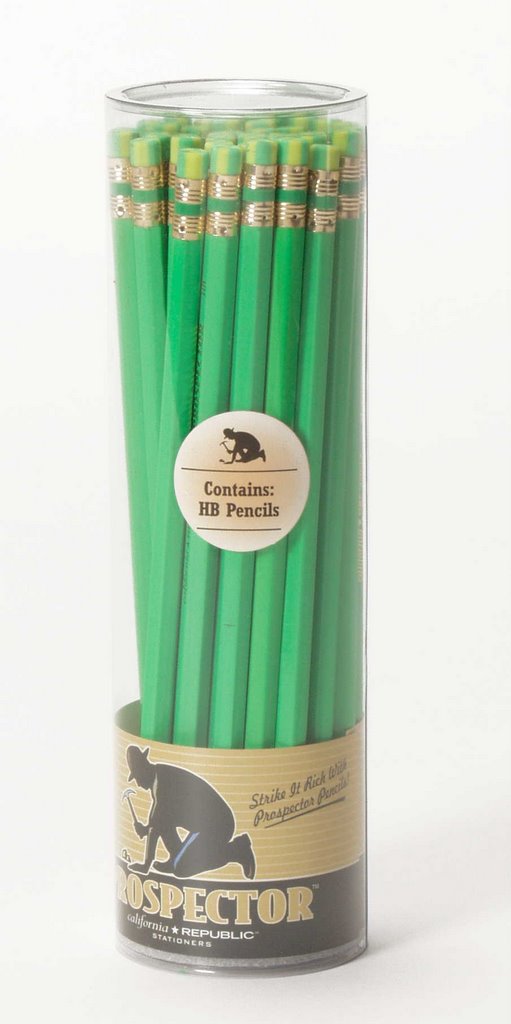
So what will you trade me for a tube of Prospector Pencils?

Tuesday, March 07, 2006

Lieber Philip: A letter lasts 100 years

Lieber Philip -

Recently Luigi has been sifting through and organizing, archival family and company correspondence. (for the uninformed Luigi is a retired employee and protégé of my grandfather Charles). Just a week ago he came up with this gem of a letter from my great-great grandfather Heinrich Berolzheimer to his son, my great grandfather and your great-great grandfather Philip.

The letter was written March 7, 1906 and is 100 years old today and begins Lieber Philip just as I've started my letter to you. In addition to the handwritten letter in German using a fountain pen there is a receipt from a factory in Nuremburg, Germany for some item Heinrich seems to have purchased on behalf of Eagle Pencil Company in New York. It also included a handwritten note by Philip on an Eagle Pencil Company envelope indicating that this was among the last letters he received from his father before his death. I have added an Eagle Diagraph pencil from my collection as a finishing touch for the photo.

Here is a bit of background history on your great-great-great Grandfather Heinrich, which even you are probably not very familiar with. Heinrich established Eagle Pencil Company in New York after emigrating from Fuerth near Nuremburg, where his father Daniel Berolzheimer had first entered the pencil industry in 1856 in partnership with Leopold Illfelder under the name of Berolzheimer und Illfelder. This 1856 date is commonly considered the founding date of Eagle Pencil Company though the Berolzheimer-Illfelder partnership did not end until approximately 1861 and Eagle was not actually established in New York in 1856. Here's a link for some information I found on the history of Eagle Pencil Company. There are a few notable errors here with respect to generational relationships of different Berolzheimers to Heinrich but perhaps you'll learn something new of interest about the pencils side of the family business background here.

After a number of years in New York Heinrich turned the business over to his sons Philip and Emil and returned to Germany for his retirement where he was involved in a number of philanthropic pursuits. This included the construction of a new library for the city of Fuerth in a building which was and is still named the Berolzheimerianum in his honor. This building has in the recent 10 years found new life as a refurbished dinner theater and comedy club. I have not seen a show there myself, but did visit the building ten year ago in 1996 and met the comedy group leaders as they were completing construction and about to open. I was even interviewed on the local television and newspaper during the visit.

Thanks to your aunt Tanja's help we have been able to decipher the main content of the letter itself. Of particular note are indications that Heinrich had recently received a letter from Philip's wife Clara with a note from your own great-Grandfather Charles (not quite 4 years old at the time) and that despite his health he was able to sit outside thanks to unseasonably warm weather for that time of year. The letter also includes a summation of a few financial figures in German Marks. One figure is the amount of 222.20 Deutch Marks from the included receipt from Nurnberger Mettal und Lackierwaarenfabrik, apparently a supplier of metal and lacquer materials to the pencil industry.

Given the 100 year anniversary of this letter today I thought it might be interesting to share with you what I see as a few of the interesting changes and developments in 100 years time that are reflected in the letter. The first is the change in language and handwriting itself. In interpreting the letter Tanja indicated there has been significant change in the meaning of particular words which she refers to as "old German". Also, the style of handwriting includes a number of letters which appear to be one letter if using current writing style, but were actually read as different letters at that time. This could even change the meaning of some of the words and sentences if interpreted improperly.

The age and somewhat faded nature of the ink complicated Tanja’s task and made at least one sentence totally unclear and she was unable to translate due to a variety of potential meanings of the few legible words. One wonders if this letter had been written with a graphite pencil rather than ink would it be more smudged or would it have stood the test of time. Given the clear legibility of the graphite pencil note by Philip on the back of the letter that indicates the date he answered the letter I could make an argument for pencil over ink. How about this? "Ride the Palomino, the mark that will last over 100 years."

I was curious what the current value of the receipt for 222.2 Marks would be in US dollars today. With the help of this site I was able to estimate it was worth approximately US$53 in 1906 using the pre-WWI rate of exchange. Using this second site it appears this amount in 1906 would be roughly equivalent to US$1085 today. Just think if you would begin setting aside just $53 per year today for the rest of your life what it might mean for your great-great grandchild in 100 years time.

Unfortunately, the description tied to this amount simply has the title "Brother Bing" so it's unclear what this receipt is specifically for. I had hoped to estimate what the cost of some parts or equipment would be today. By the way I have no knowledge of any relative named Bing, just in case you were wondering. Of further interest to me is the timeframe involved in trans-Atlantic mail communications 100 years ago. The letter dated March 7, 1906 was received in New York and Philip's handwritten note indicated he answered back with his own letter on March 20th. So a maximum of 13 days time for delivery. An eternity compared to the near instantaneous responses we expect today using e-mail for business to our factories in China and Thailand and that you and I use for personal communication. I can't remember the last real hand written letter I sent or received via mail. I'm guessing your wondering when you ever received a written letter of any sort from me. I guess this electronic version will have to suffice.

A final note of interest is the signoff which reads "Your Loving Grandfather", using the word “Opa”, though we know the relationship was father writing to son. Perhaps the translation and meaning of the word could have simply changed in 100 years time. Whether this is it or this implies some form of senility in Heinrich's waning years or was simply used as a term of endearment is unclear. I'm sure by now you are wondering about my own state of mind writing an open letter to you my teenage son in a post for the world to see on my blog. In any case the use of this language seems warm and heartfelt though sadly not typical these days of what I would expect to receive in a note or e-mail from my father Philip or I expect what you would anticipate receiving from me. Since I'm feeling nostalgic and perhaps in time you’ll reread this and feel this way too I suppose you'll eventually forgive me if I follow the example of our forefather Heinrich.

Lour loving father,
Charles