Showing posts with label Pencil Info - General. Show all posts

Tuesday, May 31, 2011

Cumberland Pencil Museum Turns 30

This morning I found the following link to a story covering this past weekend's 30th Anniversary Celebration of the Cumberland Pencil Museum. The museum is located in the heart of England's Cumbria lake district in the town of Keswick in what was formerly the canteen of the Cumberland Pencil factory. The factory itself was relocated to a new state of the art facility 3 years ago in the town of Lillyhall.

Not just an interesting place for kids, the museum celebrates the history of the pencil and has a number of fun an quirky aspects to it. It's location and that of Cumberland Pencil was originally due to discovery of natural graphite in the region and mining of the graphite. Today the region is best known as a tourist destination and the museum itself hosts 80,000 visitors per year.

I had the opportunity to visit the museam with my wife and son Philip in 1998 when he was 11, long before he joined us at CalCedar to work in our Pencils.com e-commerce operations. This was during a business visit to Cumberland relative to our Cedar slat supply for thier pencil production. Given the long business relations between our companies he also had the opportunity to get his first ever tour of a real pencil factory in addition to the museum itself. Something of great fascination for any young person and adult alike.

The article covers some interesting aspects of the museum two of which of particular relevance to me was the mention of the Charles & Diana Royal Wedding Commemorative pencil tin and in particular the secret "spy pencil" produced by Cumberland during World War II which housed a hidden compass and map inside and was used by aviators to provide a route home in the event of being shot down. The article mentions that there are only 10 of these in existence. Not sure if that is really the case, but if so that's quite remarkable as we happen to have one here in California. It's part of a special commemortive gift set of Cumberland Pencils produced for one of the company's anniversaries and was given as a gift to my father by the Managing Director of Cumberland many years ago. I also have a Charles and Diana Royal Wedding pencil in my own collection as well, though I don't know if this was part of the Cumberland set or was produced by Chambers Pencil Company, a former producer of novelty and advertising pencils in England.

Coincidentally, it's my other son Thomas' birthday today. Happy Birthday T!

Wednesday, September 08, 2010

Nobel Economist Paul Krugman loses to a Pencil

I realize you're probably expecting a new "Revival of the Blackwing" post today, but just saw this and could not resist this bit of pencil related satire from Op-Toons Review. It directly references topics I've covered here in the past from Leonard Read's essay, "I, Pencil".


I particularly loved the line:
"It wasn't fair," Krugman complained after the show. "The pencil represents a vast collection of information that could never result from the orders of government bureaucrats working with economics experts like me. That blasted pencil is the product of a staggeringly sophisticated but spontaneous free enterprise..."
Read the full story here.
Don't worrry fans. Tomorrow you'll get to read why we're bothering with this whole Blackwing Revival thing anyway.

Saturday, March 13, 2010

Palomino fares well in Pencil Test


Recently I came accross yet another pencil bench test comparing various graphite drawing performed pencils including our California Republic Palomino 2B as well as General's Kimberly and others.

Found this posted to our Palomino Riders group page on FaceBook by Tom Smolinski on his smomotion blog. Check out his animation demo reel here. Always glad to learn the Palomino has gained another fan in the animation and illustration community.

Friday, February 06, 2009

Frankfurt Paperworld 2009: Pencil Report Part 1

Frankfurt Paperworld 2009 is a few days behind me, though I still have quite a follow-up list from my meetings with customers and suppliers. Thus posting my Paperworld Pencil Report for you enthusiasts out there has taken a back seat. I do see there were a few other “reporters” out there covering new pencil related items they found. Some of these items I’ll comment on in the context of my post which will be more focused on common themes and trends for the show this year as relates to pencils and the pencil industry. Of course pencils are just a very small part of Paperworld which covers so many product categories and some themes I cover are applicable to these products as well.

The first theme seems to be the ever increasing barrage of marketing and promotion of “Green” products and processes to produce not just pencils, but many writing, art and stationery items exhibited this year. The fascinating thing to me about this is how many different types of green positions, often conflicting in message, that are being espoused for various products. Some efforts I simply consider “green washing” while others offer legitimate improvements in environmental impacts related tor raw materials used or production processes employed.

Wooden products have long been positioned as green for the renewable resource characteristic of the raw material. The addition of various and competing forest and Chain-of-custody certification schemes such as FSC and PEFC are more and more frequently used in our industry, primarily for paper products, pencils and more traditional building materials, though less often seen at this point for other home, office and school products produced from wood. While these schemes are much well known and supported by consumers in Europe there is increasing awareness here in the US. More and more often pencil manufacturers are moving towards implementing some form of third party certified wood pencil for a broader portion of their product range. This is especially in the light of new regulatory actions such as the 2008 amendment to the US Lacey Act which seeks to extend protection of endangered plants to include all manner of wooden products imported to the US. Similar legislative actions are under review in Europe and will be an increasing challenge not just to the pencil industry, but the global wood products industry as a whole. I expect to write more on this legislative topic and its projected impact on the industry in a future Timberlines post.

The most notable new certified wooden pencil at Paperworld this year is the new STABILO Green Range (image above). This range from Schwan-STABILO features the 100% FSC certification label and initially covers about 4-5 different pencil products with the intent to add new FSC certified pencil items over time. For more information see the STABILO Green Pencil Library Wiki page at our Pencils.com site. Of course Faber-Castell has long touted their leadership in FSC certification of the majority of their pencils and other European brands such as Caran d’Ache have had FSC certified products for some time, as well as our own California Republic ForestChoice brand which was the first FSC certified pencil offered to the market. As the leading supplier of FSC certified Incense-cedar and FSC Basswood to the pencil industry our company is experiencing increased demand for our FSC certified pencil slats.

Plastics and recycled products are also increasingly positioned as green. Our industry is clearly experiencing a re-emergence of the extruded plastic pencil. It was even interesting to see some standard PVC type plastic products from Asia being positioned as green simply for the fact they are “woodless”. However, most of the traditional plastic pencils are actually a composite of wood flour and plastics so technically they are not woodless. The Remarkeable Pencil has different versions produced from recycled cd cases, plastic cups and a variety of other materials. Bic’s Conte Evolution has been the market leader in plastic extruded pencils ever since Newell discontinued production at the former Empire EPCON facility in Shelbyville, TN some years back. However as BIC long since stopped exhibiting at Paperworld I am not certain what specific environmental claims they make regarding the Evolution these days. Chinese and other developing country companies have increased investment in plastic pencils production as well, though in these cases it’s most often to address economic concerns as wood costs for pencils have been increasing over past several years.

The major announcement on the extruded pencil front is the new Staedtler WOPEX pencil which they gave top billing and emphasis as their new product at Paperworld. This pencil has already been reported on at Lexikaliker blog in German. I was able to meet the Director of R&D at Staedtler who presented this product introduction to me. First, the name is a form of anagram for the words Wood, Pencil & Extrusion. I did find it somewhat interesting that a leading German writing instrument company used an English anagram to name its new product, but I guess this simply reflects the current state of the use of English more globally. The key features of this pencil are that a full 70% of the raw material used is wood flour. So Staedtler is pushing the recycling of wood and minimization of recycled plastic with respect to environmental positioning. Also the pencil is definitely more rigid than other plastic pencils I have seen and they indicate they will produce it in three grades H, HB & B. It did write better than my experience with most other plastic pencils. Finally the rubberized surface has more ergonomic properties similar to their Ergosoft range. As I understand it they do not intend this to be a cheaper substitute for wood pencils, but a value added product preaching it’s performance and green benefits.

That’s it for this Part 1 report as it got way longer than planned, as usual. Tune in for Frankfurt Paperworld 2009: Pencil Report – Part 2 where I’ll focus on the industry impacts and reactions to the current World Economic and Recessionary environment.

Wednesday, May 07, 2008

170 Years of Made in Germany

I have just completed a new post in the Pencils.com Collectors Corner Resources page that discusses an interesting point about country of origin marking. This relates to a press release I recently read from Staedtler on the 170th anniversary of thier produciton of pencils in Germany. You can link direct to this post here.

Note that there is no intent to disparage Staedtler's reputation here just to use this post to point out a seeming global disparity in country of origin marking regulations. In Mexico the rule is different than both European Union and in the US and reliyes on % of value added content in Mexico, while US's rule is based on theory of substantial transformation.

Wednesday, April 30, 2008

The Myth of the Yellow Pencil


With the recent 150th anniversary of the patent of the eraser tipped pencil, I have seen several new references around the web about pencils and a few indicating that 75% of pencils sold in the United States are painted yellow. At our Pencils.com site we explain the history of why so many pencils are painted yellow in the US. It's not clear to me where this estimate of 75% comes from however. Our site simply states that a majority of basic graphite writing pencils sold in the US are painted yellow and given today's market that may be generous. I have not checked Henry Petroski's book as it certainly has a reference to the genesis of painting pencils yellow although I can't recall if there is some figure stated for proportionof market as yellow painted pencils. Even so that book is now roughly 20 years old and market conditions have changed dramatically over that time. So perhaps it's time for a new look at this old story and the trends in the US pencil market that impact this.

My approach is first to view the US pencil market by it's key product category components & sub-components which include:
  • graphite pencils for office, school & home use
  • color pencils for school, home or artist use
  • carpenter pencils
  • cosmetic make-up pencils

Of these the last two groups are relatively small segments on a unit volume basis. Based on my knowledge of the industry I've estimated these two segments would not be much more than 5-7% of the annual unit volume of pencils sold in the US. Although with a higher average sales value per unit than graphite or color pencils it may be perhaps 8-10% of the wholesale sales value. Virtually none of these pencils are painted yellow though some proportion of carpenter pencils may be yellow the most comon colors are white, red, blue and orange. So a conservative estimate removes 5% of all US pencil consumption from being painted yellow.

The next challenge is to break out color vs. graphite pencils. Historically there has been an approximate ratio of 20% color pencils to 80% graphite writing pencils. I conducted a reasonably thorough review for 2005 of US production sources and import sources of pencils. By dividing each country of origin and US producer out into known and/or my best estimate figures for color vs. graphite pencils I calculated a weighted average of 28.7% for color pencils for 2005. Of particular interest is that only a very small small portion of US pencil production is color pencils. My estimate is just 5%. With about 1/3 of today's pencils being produced domestically in the US and a full 2/3 imported from overseas this means that about 39% of the imported pencils are color pencils.

This data supports the growth of color pencil consumption in the US over the past 15 years or so. This has been driven initially by the entry of Crayola into marketing color wood cased pencils in the early 1990s. These pencils are all produced in Brazil or Costa Rica by Faber-Castell. Following the lead of Crayola many other. Of particular interest is that in Europe the ratio of color to graphite pencil consumption is more or less reversed from the US trend as historically color pencils have been the vast majority of pencils produced and sold inthe European market where pens are more frequently used for writing purposes.

Given that color pencils are usually painted the color of the core for each color in general color pencils have a very low proportion of yellow painted pencils. We could either simply discount this group entirely (as non-graphite pencils) or assume that about 1/12 of these pencils on average are painted a yellowish hue given that yellow is a primary color and as pencils are generally sold in multiples of dozen packs this proportion should hold about true as the color pallet expands for 24, 36, 72 and 100+ count boxes of color pencils. Thus at best 2 to 3% of US pencils are color pencils that are painted some form of yellowish hue.


Thus my analysis indicates that perhaps only 66-67% (100% less 5% carpneter/cosmetic less 28-29% color pencils) or approximately 2.9 billion graphite pencils per year are sold in the US today. So even if 100% of graphite pencils were painted yellow only 2/3 of US pencil consumption would be yellow pencils. Adding 2-3% yellow coloring pencils still doesn't get us to 75%. However there are several major sub-categories of graphite pencils including:

  • advertising specialty pencils for custom imprint purposes (hexagonal and round shapes)
  • golf pencils (hexagonal and round)
  • designer theme pencils (includes licensed character/sports pencils, holiday themes, and other decorative themes ( generally round)
  • artist quality graphite drawing and sketching pencils
  • standard branded writing pencils (mostly all hexagonal shaped painted a single color)

It is really just this last group of more standard branded writing pencils that have traditionally had a very high proportion of yellow painted pencils. And frankly it's likely this last group of pencils that the average person is probably thinking about when saying 75% of US pencils are painted yellow. Certainly it may be historically true that 75% of branded hexagonal graphite pencils in the US were painted yellow and it may even still be true today of this sub-segment. However as with the growth in the color pencil market the advertising specialty, golf pencil and designer theme pencils have been the key growth sub-categories of the graphite pencil market over the past 10+ years. My quick estimate is that something in the range of 50 to 70% of graphite pencils would fall within this last group in the current market and if 75% of those are painted yellow then at the upper end we are looking at just 35% (= 67% graphite x 70% to 75%) graphite yellow painted pencils as a proportion of the total US pencil market. This is a far cry from 75% and even if significantly more than 75% are painted yellow would not get much higher than 40% of all US pencil consumption . Thus it's probably not even technically correct any longer to say that the majority of pencils sold in the US are yellow painted pencils.

In fact within the pencil industry the historical intent of painting a pencil yellow as a reflection of high quality is considered out of date and yellow pencils are increasingly viewed as a low value commodity segment. Certainly some important high quality brands such as Dixon's Ticonderoga , the Mirado (originally the Eagle Mirado now Sanford's Papermate Mirado), to some extent the Mongol (though now discontinued in the US by Sanford) and a few other minor brands have a good quality reputation and retain yellow as the primary lacquer color. Some of these have offered additional paint color options within their brand range. The reality is that today the vast majority of yellow pencils sold in the US are imported low priced pencils. Many of these are private label pencils for the major office supply chains. The Papermate American brand remains one higher volume yellow hex pencil that is still US produced to a large extent, but the quality has been reduced considerably to compete with the imported pencils. Alternate species woods have reduced sharpenability performance, lower standards on lacquer finish reduce the look and feel of the pencil, ferule and eraser quality reductions and graphite smoothness inconsistency, are today unfortunately often the case with common yellow pencils.

While all this means more affordable pencils for general writing needs it's also changed the perception of the yellow pencil over time. Today's standard commodity yellow pencils cost about $0.10 per pencil at retail which is surprisingly the same as the price of a Ticonderoga, a Mirado and other high end brands 40, 50, 60 and even 70 years ago now. When you consider the value of the dollar today vs. it's value over those time periods you'll see common yellow pencils are effectively much cheaper in real dollar terms than they ever were. I'm not sure what milk, gasoline and many other common consumer goods cost that long ago relative to today's prices, but I'm guessing the relative value retention for the yellow pencil has been quite good although the qualtiy on average is just not what it once was and may or may not compare favorably with quality performance of other common goods that have had relatively more infalated values over time on a real dollar basis.

Saturday, March 29, 2008

The New Pencils.com


After several months of work I am pleased to announce we have completed our redesign project and have now re-launched our “Incense Cedar Institute – Pencil Pages” website under the new name Pencils.com. This has been a project some time in gestation even since I first initiated my Timberlines blog a few years back and happily is now up and running as a Beta site which we will continue to work on improving and developing over time.


The new Pencils.com site builds upon the past purpose of the site as an educational resource regarding pencils, Incense-cedar, renewable resources and forestry management but adds to it a broad range of new features designed to help celebrate and share the role of the pencil in our world. If you are a pencil enthusiast, artist, writer, teacher, parent or student the new site has something for you. I hope you will check it out and join what I think will become an active and growing community. In particular we have initiated a Palomino Riders group page which allows you to share and post artwork created with your Palomino pencils or to form other groups and discussion forums on a wide variety of topics related to education, art, writing and even pencil collecting.


In addition to expanded educational content and a host of social networking and related tools on the Pencils.com site one of the key new features will be our Pencils.com Store. This store will supplement our existing Pencil World Creativity Store @ eBay and ForestChoice.com and offers a much more flexible on line shopping tool with quantity discounting, pencil points discounts that you earn through participation in the Pencils.com community as well as other features. We’ve already added an expanded range of new California Republic items not on eBay as well as new items from another pencil manufacturer with more to follow. Over time we’ll be expanding the product range available on the Pencils.com Store, supporting and promoting products produced by our slat customers that supplement and complement our own product range.


A number of readers continue to request more of my in depth posts on industry issues and there have been plenty of issues to write about, although I’ve just been too busy with other business matters in the last year or so and more recently in developing the Pencils.com site for this launch. Looking forward I plan to return to providing somewhat more frequent posts about issues related to Pencil Industry here on Timberlines which will also have a feed to a dedicated Timberlines page at the Pencils.com site. However, posts more focused on news related to our California Republic Stationers product developments and the Pencils.com store offerings will be moved to my WoodChuck blog on the Pencils.com home page. Thus the Pencils.com site will be updating much more frequently than Timberlines going forward.


For more information you can visit Pencils.com or for more historical background of the Incense Cedar Institute and website transition to Pencils.com you can read the CalCedar press release here.

Thursday, October 18, 2007

Could Blackfeet Become the Next Blackwings?


Earlier this week we had an inquiry from a consumer looking to find a supply of Blackfeet Indian pencils. I had to pass along the news that the Blackfeet Indian Pencil Company is out of business for sometime now. The linked article here provides an interesting look at the challenges faced by Blackfeet Pencil Company as they last tried to re-establish operations around 2000. Unfortunately the company was not able to recover from its prior debt load and the changing competitive environment as increasing volumes of pencils entered the US market from Asia..

The best advice I could offer this person was to try eBay and I was able to provide a link to a current auction at the time. Today this auction for a 12 pencil wood box set of “The Blackfeet Indian Pencil” ended at a total value of $62.25 plus $4.50 shipping for a whopping $5.56 per pencil. Certainly this includes the nice redwood wooden box that these pencils come packed in, but still seems quite a premium as compared to our own Palomino Wood Box sets priced at $9.95 for 6ct on eBay or Pencilthings.com’s Palomino Signature 12 count Wood Box Set at $16.95.

So will the now discontinued Blackfeet Pencil develop a similar sache to that of the famous Blackwing? This auction does not represent the amazing $20 to $35 each pencil premiums that Blackfeet pencils fetch that these days. Certainly there is a bit of emotional attachment some people place on buying a pencil produced by Indians that once benefited and supported one of our Native American cultural groups. The pencil writing performance is good, but not to the quality of the Palomno or many premium quality writing pencils available today. The natural wood grain finish is a nice feature, but in and of itself is not uncommon these days. In fact most people associate the all natural finish of the Blackfeet Indian Pencil with their image of this brand, but the company did produce a broader range of pencil styles and brand names as exhibited in this nice collection. Certainly there has been some attention to Blackfeet pencil at Pencil Revolutions and Paper and Pencil. I guess only time will tell if we’ll be seeing $10 or $20 Blackfeet on occasional auctions of this item.

Tuesday, October 16, 2007

Palomino & California Republic Notes

Hello all you fellow Palomino Riders out there. I'm long past due in providing an update on developments with the Palominos and other brand ranges in our California Republic lines.

First, over the past few months we ran a test with some larger bulk pack formats with banded dozens in 36 and 72 count packs. We've had very positive reaction to this packing format. We ran through most of the stock on hand from this test and have just a couple remaining packs available on Pencil World Creativity Store both here and here. You may want to pick these up while they last.

Partially as a result of these tests we have reached a decision to make the banded dozen format more widely available for our internet distribution channel. In addition the banded dozens will be extended from the Palomino brand to also include all items in Golden Bear and Prospector ranges and even a few new Spangle items we plan to introduce by year end. We are a still a while off before these formats are formally introduced on a standard stocking basis, but do expect to have these up by year end. So keep your eyes peeled for this new option going live and I'll provide more details when teh new stock arrives and we are ready to go live.


In the meantime if you've found you do have an appetite for bulk pack pencils we do have ready supply of our popular ForestChoice FSC certified pencils in 1 gross (144 ct) bulk packs. These are available both here at PWCS @ eBay or at our ForestChoice website.

Also comming soon we will be adding an eraser tipped option in our Palomino Blue HB, as well as a few varieties of Spangle jumbo size school learning pencils in both round and triangular shapes.

Finally, I am making the commitment once again to more frequent posts on Timberlines so look forward to a series of new articles and weekly features covering a variety of topics. I know I got started last Spring and then didn't keep up. This time.


Thursday, April 26, 2007

This Guy is "Mad, Crazy"


I would like to introduce to you the interesting misadventure of Tyler Farrer who’s new blog Make One Pencil chronicles his efforts to make one pencil all by materials and tools made and acquired only by himself. This effort is inspired by the famous essay entitled I, Pencil first published by the Economist Leonard E. Read in 1958.

Tyler describes himself as follows:

I am a self-proclaimed "Free-market", "Free-Trade", and "Capitalism-loving", "globalist". I also believe that it was probably impossible for one man to make a pencil in 1958. Will it be impossible in 2008? I don't know, but I want to be the one to try.

Another description might be simply he’s “mad, crazy”. I told him I’d like to help with raw material supplies given my involvement in the industry, but that would defeat the whole purpose of “one man, one pencil”. He can’t just buy the pre-manufactured components and assemble them either, to follow the concept of Read’s essay he has to produce the tools to produce the pencil and then the final product all by himself. As it is he’s at least benefiting from the internet as a resource on how to make the pencil since he doesn’t have to invent it just make it from scratch. He’s asked for financial contributions on the website, but doesn’t that defeat the “one man, one pencil” credo also?

But what real basis do I have to claim Tyler is “mad, crazy”. Simple, he’s working against some of the greatest principles of economics. He’ll either end up broke producing one pencil for some outrageous cost if he succeeds at all or he will have a breakdown ending up needing major therapy and probably pharmaceutical treatment as well. What’s more he knows all this to start as a good a good "Free-market", "Free-Trade", and "Capitalism-loving", "globalist”. If he’s not really insane now he may well be after this effort.

If you’re unfamiliar with I, Pencil I encourage you to read it. It’s essentially a lesson in these great economic principles best summarized by Milton Friedman in his Introduction to the essay on the Library of Economics and Liberty website. In Milton’s own most eloquent words:

I know of no other piece of literature that so succinctly, persuasively, and effectively illustrates the meaning of both Adam Smith's invisible hand—the possibility of cooperation without coercion—and Friedrich Hayek's emphasis on the importance of dispersed knowledge and the role of the price system in communicating information that "will make the individuals do the desirable things without anyone having to tell them what to do."

Milton even used this essay in his popular TV Show “Free to Choose”. Anyway Tyler’s Make One Pencil quest strikes me as very coincidental timing as I have recently been re-reading various Milton Friedman works. So I guess this post can serve as a bit of my own memorial to Milton.

Finally, if you need any further support for my prediction of Tyler’s fate I encourage you to read this post at the Reach Upward blog. This is where his flash of brilliance to begin this odyssey got its initial spark. In any event I am very much enjoying Tyler’s prolific posts so far and intend to follow his progress and offer my moral support. It’s really all great fun and I’ll leave the decision to make financial contributions up to you. All the best of luck to Tyler.

Image Note: Particularly fitting for this post the drawing above by Dan Mignano was a runner up in one of our Incense Cedar Institutes Pencil Doodle Contests from the mid 1990s. The theme "No. 2 Pencil, Still No. 1 in a High Tech World."

Tuesday, April 24, 2007

Pencils: Popular in Any Language

One of the most common questions I receive from those who learn I work in the pencil industry is "How do you get the leads into the wooden pencil?" This leads to any number of further questions and discussion about different aspects of the pencil business according to what any particular person finds interesting. There is no shortage of interesting and related topics depending upon how detailed and how technical one wants to get. In reality I have only touched on a very few areas in all the posts about industry issues over the past 18 months or so, whether it's anti-dumping duties, environmental aspects of forestry management and FSC certification, etc. FYI: Today I've added Labels to most of my posts so it should be easier to find different posts by subject matter.

Yesterday I came accross the following post "¿Cómo se meten las minas en los lápices de madera?" which answers just this question on the general interest Spanish language blog Ya está el listo que todo lo sabe (Here is the list of everything to know). The post includes a brief history of the development of the graphite pencil and a description of the pencil manufacturing process. This post as many other websites I have found over the years has liberally borrowed the photo from our How to Make A Pencil page on our Incense Cedar Institute Pencil Pages site on how pencils are made.

What I found most interesting about this post was the "commentarios" left by readers and in particular a long treatise on the wood used in pencils by Dr. Amio Cajander who provided a knowledgeable discussion of the use of Incense-cedar ,other pencil woods and even composite substitutes in his long comment in addition to describing some of the technical factors that make for a good pencil wood. He even generously noted my Timberlines blog as a resource for his information for those who wished to practice thier English. Additional comments indicated readers seemed generally interested in learning about how the pencil was made. This is not unlike my experience with reactions to my Timberlines posts and our feedback over many years from information provided on the Incense Cedar Institute Pencil Pages.

While my Spanish is just okay, I was able to make my way through this post relatively easily and it was good practice. So for those interested in testing their Spanish, practicar aqui.

Honestly, it's nice to see that there is such interest in the manufacturing process and the pencil itself from all over. I would take the time to link to a few other foreign language sites on the topic of how pencils are made that I've found over the years, but unfortunately I never bothered to save any of those links. So if you're visiting from another country and know of any such web pages in your native tongue please feel free to link to these in a comment to this post.

Thursday, March 30, 2006

Welcome Pencil of the Month™ Club


Our friend and colleague Don over at PencilThings.com is starting a Pencil of the Month™ Club . Just $24/year for a monthly edition of a new pencil each month. Link here to join or you can read more details here at Pencil Revolutions.

We are pleased Don is getting off to a good start with his new PencilThings venture which is becomming the definitive source for KUM sharpeners and a growing list of our own California Republic pencils in our Palomino, Golden Bear, ForestChoice & Prospector ranges in addition to more new "pencil things" everyday. His efforts are quite a compliment to our own Pencil World Creativity Store @ eBay making a wider range of PencilThings available than we at California Republic have the time to focus on for our own more limited eBay offerings.

We are excited to collaborate with Don to help him locate and source interesting pencil items for the club's monthly listings and look forward to the fun ahead for fellow Pencil Revolutionaries.

Friday, November 18, 2005

Wood Cased vs. Mechanical


A little while back there was an interesting debate among Pencil Revolutionaries regarding the various benefits and drawbacks of wood cased vs. mechanical pencils. (See "Can't Corral that Palomino") I was of course happy such a passionate discourse resulted from a post on our new Palomino Mixed Grade Graphite pencil set, but the real benefit for me came from the comments themselves.

As an industry participant I was intrigued by the detailed consideration of performance characteristics of these alternate pencil types. It was somewhat like sitting in on a focus group discussion and though certainly a limited sample size of true enthusiasts I did find some ideas that we manufacturers and marketers could further explore. Of course, many of these ideas have already been addressed in various forms by manufacturers of both styles of pencils. However, the challenging aspect for me is to think about what performance benefits and objections people expressed regarding wood cased pencils and how creative product solutions to those might expand the wood cased market through new customer conversion.

One of the key "objections" about wood cased for mechanical pencil fans is the need to continuously sharpen pencils versus the simple clicking action of mechanical when doing extended writing or note taking as opposed to drawing or sketching where most seemed to favor wood cased. Harder grade leads are certainly one option to reduce frequency of sharpening. This has it's limitations though as it negatively effects the darkness many pencil users prefer from softer leads, which by the nature of their physical properties simply wear at a faster rate. Naturally, it seems that perhaps a "sharpenless" wood cased pencil might find a niche of new converts if it combined the ease of use of a mechanical with the attractive feel an emotional sache of a good wood cased pencil.

Other than simply encasing a mechanical type pencil with a wood casing, which is not a new idea, I can't say that today I have a real design concept for a truly unique sharpenless wood cased pencil. Whether such a concept is achievable or there really would be an attractive demand is uncertain. The world is full of interesting product concepts that don't really achieve mcuh commercial success. Recently we received a proposal to market someone's design for a pencil with about 1/2 of the total length made up of a long eraser. The concept allowed the user to peel back the "cardboard type" ferrule to expose more eraser as needed. We declined as I could not see the economics working well for this combination versus the simple use of an eraser topper wihch is reusable with other pencils and more cost effective. More often than not the typical pencil eraser is not fully utilized and is wasted anyway, so why make it longer.

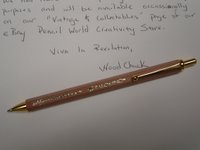
In the meantime I can announce our first eBay auction listing in our new "Vintage & Collectables" Category on the Pencil World Creativity Store. This is a single Palomino Wood Cased Ball Point Pen which is one of a limited set produced as Premium gifts when we first initiated our California Republic product line. Unfortunately, I don't have any of these which are mechanical pencils with a Palomino quality lead that I might call the "Sharpenless Palomino Pencil". Perhaps one day.

Finally, I am pleased to note that following an important Revolutionary's detailed technical analysis our Palomino HB and 2B pencils has resulted in their selection as the winners of the most favored replacement to the famous Blackwing 602 pencil which is no longer in production. In addition, we are pleased to announce that the Palomino HB is now also available as part of the new Moleskine Gift Sets at Ninth Wave Designs eBay Store. Ninth Wave Designs has become an authorized dealer of our California Republic and ForestChoice pencils and we look forward to seeing more combination Moleskine pencil sets using our Palomino and ForestChoice pencils in the future.

Tuesday, August 30, 2005

The Pencil as Art

Photo Credit: C book

Back to the creative side for a day.

We generally think of the use of pencils to generate art. However, it seems the pencil itself is continually viewed as a source of inspiration for artistic expression in several media. Here are links to a few interesting examples:

Photography

Sculpting

"Pencil Pricks" Daily Cartoon Series


Saturday, August 27, 2005

Revolutionary Reviews

Well it looks like the revolution is truly underway. The latest in the ongoing series of Revolutionary Reviews covering the infamous Dixon Ticonderoga pencil seems to have generated quite some discussion over at MetaFilter. This time around PRevo invited guest reviewer Tom Leininger to cover his favored "Tikes". While there seems to be some lively commenting regarding the review itself, it's clear there are a lot of fans of the Ticonderoga pencil.

This is the third in Pencil Revolutions ongoing series of product reviews. Earlier reviews covered the Papermate American Naturals and our own FSC certified ForestChoice graphite pencils.

We're looking forward to seeing how the continuing revolution develops.

Sunday, August 21, 2005

Explore the World of Pencil Collecting


Given my family history in the in the pencil industry it’s not too surprising I tend to have a wide selection of pencils stashed in desks, drawers, closets and cabinets around my house, my office and even the car. A few years back when redecorating my home office I spent some time actually going through pencils that had accumulated over the years. Some even dated to my childhood that found their from that of my parents when an old desk and group of boxes were delivered as part of their own cleanout process.

Among the clutter there were indeed a few gems from a collecting standpoint. Since that time I have become increasingly interested though not always too active in broadening and expanding my collection. This collection includes not just pencils themselves but old advertising materials I feel have some of historical or design interest. A few my own personal pencil favorites relate to our family heritage within the industry dating back to the 19th century with the Berolzheimer und Ilfelder and the early 20th century from the Eagle Pencil Company. The Eagle Diagraph pencils shown here have a very interesting knurled effect in that they were rolled in a steel die which imprinted the surface to provide this interesting texture in order to improve grip. The compass is one of my favorites due to the detailed design in the metal work. For more views of various Eagle brand pencils visit the Pencil Images Gallery at Doug Martin’s Pencil Pages. His site is the most extensive online respurce dedicated to collectors.

Pencils are of course considered collectables by children and adults alike. People specialize within their collections in all sorts of forms such as advertising pencils, old brands and their transitions and developments throughout the years, coloring pencils, carpenter pencils, cosmetic pencils, etc. In Japan, a few years back a few producers even developed a series of “game” pencils decorated with popular cartoon characters with each side of the hexagonal pencil representing a different outcome when the pencil was rolled. Children battle it out on pencil rolls for the fate of their game character pencils.

So what gems might you have stashed away in a drawer somewhere?

Tuesday, August 16, 2005

We're a Proud Bunch: Who's Got the Biggest Pencil?


Those of us in the pencil industry are all quite proud of the origins and traditions of our companies. Many of us like to tell our historical tale of product innovation and organizational development. A number of us even claim to have produced the world’s “___est” pencil. Pick your adjective.

But where does one go for a good insight into the overall industry history?Henry Petroski's “The Pencil: A History of Design and Circumstance” is considered to be the most definitive history of the development of our industry. Many insiders however view a few facts pertaining to their own company history as not fully accurate. Some may even contest some of Petroski’s statements regarding which company first achieved various technical developments.To be sure there is plenty of interesting history in our industry.

Given the age of many of the companies even some of the factories may be considered museums or museum like. So here are a few historical references for your perusal.

Perhaps the most elaborate company historical presentation in our industry, the Cumberland Pencil Museum established by The Cumberland Pencil Company sits next door to their manufacturing facility located in Keswick, Cumbria, England. Here the Cumberland Graphite story is told beginning with the discovery and development of the famous Borrowdale graphite mines. Of course one of the museums key features is their “Worlds Longest Pencil” unveiled in 2001 at 25 feet 11-1/2 inches.

Many companies in the industry have a tale of growth characterized by merger and acquisition of other pencil manufacturers as well as of other writing instruments and art supply businesses in order to expand the product range. One of the leading examples of such development is Dixon Ticonderoga Company which a few years back published its history entitled "The Best of It's Kind". During a visit to their Versailles, MO facility some years back I saw their project to produce another world’s “___est” pencil, a giant Ticonderoga. We even supplied Dixon with super-sized Incense-cedar timbers for this effort, though I don’t have the final pencil dimensions available.

Among US pencil manufacturers just two company’s with production history pre-dating 1920 still trace current ownership to descendants of company founders. The Musgrave Pencil Company history typifies the early development and concentration of pencil manufacturers in middle Tennessee. Here much of the US industry located in order to attain supplies of Eastern Red Cedar which was the preferred pencil wood early in the 20th century. A number of US factories were originally established by immigrants from the German pencil industry culuster around Nuremburg. General Pencil Company reflects the last remaining US pencil producer with current ownership still related to the original German founder. To my knowledge neither of these companies has ever attempted to produce a Worlds “___est” pencil, though they both know how to make very good pencils.

Faber-Castell has a significant history in the pencil industry and has several entries in the competition for the Worlds “___est” pencil. A Grip 2001 measuring 12 meters is displayed at the company’s headquarters in Stein, Germany. Not to be outdone Faber-Castell’s Malaysian subsidiary has the Guinness Book of World Records certification achieved in Novemer 2002 for the World’s “Longest” Pencil at 19.75 meters.

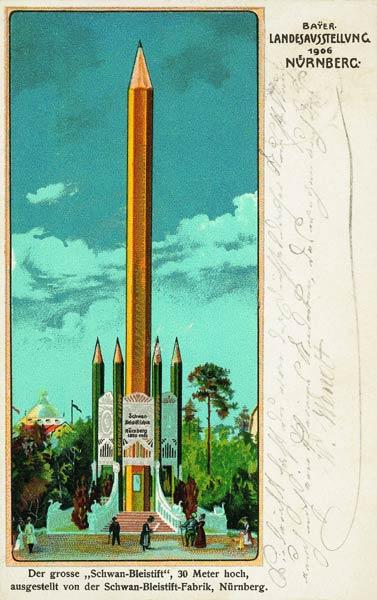
Schwan Stabilo Group's 150 Years of History represents perhaps one of the more interesting web based company history presentations for its multidimensional timeline covering History, People, Writing Products and Cosmetic Products. And of course, you guessed it, Schwan claims to have produced the Worlds “Tallest” Pencil coming in at 30 meters for the 1906 Bavarian State Exhibition (shown above). How this one got overlooked by all the recent pretenders is a mystery, though it’s uncertain if this monster was truly capable of writing with a graphite core as the others all have. So perhaps this record needs to have an asterisk attached.

Finally, we have our own historical archives and historical display at California Cedar Products Company which provides much detail on our pencil slat history. While we do claim to be the worlds leading pencil slat manufacturer and we do make a few pencils, we have never attempted to produce our own World’s “___est” pencil. I’m guessing a little more research may be in order before ever attempting such a feat.

Saturday, August 13, 2005

We make them, but how do we use them?

As a participant in the writing instrument industry I suppose I like many of us get caught up in the day to day business of making and selling pencils, pens, markers, various components, etc. We focus daily on the details of communicating with and understanding the needs of our customers; analyzing and improving costs and quality, planning and keeping up with growth trends by market segment and assessing our competitors. Many even have made detailed efforts to better understand the actual use of our products from the perspective of the artist, the student, the office worker, the carpenter, perhaps even the Astronaut. Collectively as an industry we know everything there is to know about making and selling pencils and pens.

But how do we use pencils and pens ourselves? Do we see these simply as the products through which we make our living? Or is there a creative group among us actively using our own products for writing, journaling, drawing or some other means of self expression? As a multi generational family participant in the pencil industry I feel a strong personal affinity and tradition related to our company's products and the role these products eventually play in allowing people to express themselves or contribute to the learning process.

For my own part I have never considered myself to be a very artistic person. I have experimented with both journaling and drawing, though I cannot claim to be particularly talented or committed to regular practice of either. It's usually something I'll do during a vacation; writing in my fishing journal about that day's adventure and including a simple sketch. I find that it's a relaxing and refreshing activity when I'm in a reflective mood in the evening.

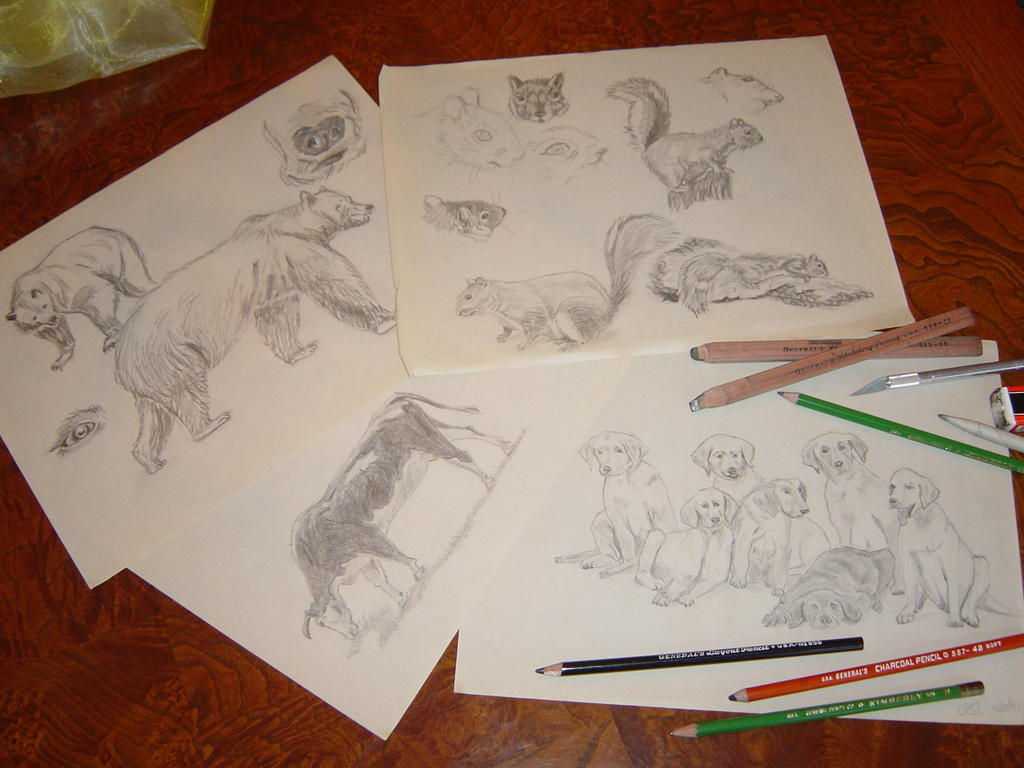
A couple years back given the encouragement and gift of drawing and sketching pencils from our good friends at General Pencil Company I once spent several days during our annual Christmas holiday on Little St. Simons Island trying my hand at sketching. I worked from a book on how to draw animals and these are the photos of some of what came of that experiment. I tried a bit of color pencil drawing, but found that's not yet within my capability.

So what are your own creative efforts with pencil, pen or paint? Share a comment or e-mail me a digital photo of your own efforts and I'll include it in a follow up post. If you don't think your the artistic type you'll never know unless you give it the effort. For a little inspiration visit General's Art Gallery.

Friday, August 12, 2005

US Pencil Imports Continue Growth

The latest update to US import statistics for wood cased pencils support the growth trend experienced for some years now. Over the past 5 years through 2004 pencil imports into the US have increased at an average annual rate of 6.0% on a dollar value basis and of 7.8% on a unit volume basis. This is reflects an average annual reduction of 1.8% in import prices over this period. In total 2004 unit volume imports were 17.6 million gross (this 2.5 billion pieces for the year or almost 9 pencils per capita).

Our own estimates indicate that imported pencils now represent approximately two-thirds of the total US annual consumption on a unit volume basis. We estimate that the share of US manufactured pencils has dropped from around 50% of the market just three or four years ago. Given net higher average average wholesale prices of US based production the dollar market share of imports is certainly less than that of import unit volume share. Of course a number of the US producers are also selling imported pencils or also adding further manufactured value to imports of semi-finished product so the US producers total share of US consumption is not quite as bleak as indicated purely by the import statistics. Also total wood cased pencil consumption does seem to be on the rise overall and 2005 is shaping up to be a good year, though the specific growth rate year on year is a bit more of a challenge to accurately analyze. Regardless, the continuing challenges to US based pencil manufacturing remain clear.

Looking at 2005, the Year-to-Date May figures are up just 1.6% on a dollar value basis and an astounding 21.0% in unit volume vs. the same period in 2004. This indicates a significant 12.8% average import price reduction year over year. If sustained through year end the percentage increase in volume would be the largest since 1996 and the reduction in average import prices year on year would be the largest ever. In 1997 there was an 11.3% reduction reflecting the largest single year price deflation of import pencils at the wholesale level.

Another surprising aspect of import figures thus far in 2005 is the indication that the most significant import growth is not coming from China which traditionally has the largest share of imports to the US market. In fact YTD May Chinese pencil imports are off 10.4% on a volume basis. The main growth thus far in 2005 is driven by imports primarily from Costa Rica, Indonesia and Thailand and a few other countries in smaller proportion. Key countries with declining shipments to the US so far this year are China and Brazil.

It is difficult to project such trends through the full year due to seasonal factors, the most notable being that distribution channels load up in the early part of the year to prepare for back-to-school shipments. So the final wood cased pencil import picture and trends by country may yet be different by year end. Other issues that may impact these trends this year or as we look forward to 2006 are the recent decision by China to allow the Yuan to float and changes in relative anti-dumping duty rates on Chinese imports for some manufacturers. See my upcomming discussion and update on anti-dumping and other pencil trade issues next week.