Tuesday, March 07, 2006

Lieber Philip: A letter lasts 100 years

Lieber Philip -

Recently Luigi has been sifting through and organizing, archival family and company correspondence. (for the uninformed Luigi is a retired employee and protégé of my grandfather Charles). Just a week ago he came up with this gem of a letter from my great-great grandfather Heinrich Berolzheimer to his son, my great grandfather and your great-great grandfather Philip.

The letter was written March 7, 1906 and is 100 years old today and begins Lieber Philip just as I've started my letter to you. In addition to the handwritten letter in German using a fountain pen there is a receipt from a factory in Nuremburg, Germany for some item Heinrich seems to have purchased on behalf of Eagle Pencil Company in New York. It also included a handwritten note by Philip on an Eagle Pencil Company envelope indicating that this was among the last letters he received from his father before his death. I have added an Eagle Diagraph pencil from my collection as a finishing touch for the photo.

Here is a bit of background history on your great-great-great Grandfather Heinrich, which even you are probably not very familiar with. Heinrich established Eagle Pencil Company in New York after emigrating from Fuerth near Nuremburg, where his father Daniel Berolzheimer had first entered the pencil industry in 1856 in partnership with Leopold Illfelder under the name of Berolzheimer und Illfelder. This 1856 date is commonly considered the founding date of Eagle Pencil Company though the Berolzheimer-Illfelder partnership did not end until approximately 1861 and Eagle was not actually established in New York in 1856. Here's a link for some information I found on the history of Eagle Pencil Company. There are a few notable errors here with respect to generational relationships of different Berolzheimers to Heinrich but perhaps you'll learn something new of interest about the pencils side of the family business background here.

After a number of years in New York Heinrich turned the business over to his sons Philip and Emil and returned to Germany for his retirement where he was involved in a number of philanthropic pursuits. This included the construction of a new library for the city of Fuerth in a building which was and is still named the Berolzheimerianum in his honor. This building has in the recent 10 years found new life as a refurbished dinner theater and comedy club. I have not seen a show there myself, but did visit the building ten year ago in 1996 and met the comedy group leaders as they were completing construction and about to open. I was even interviewed on the local television and newspaper during the visit.

Thanks to your aunt Tanja's help we have been able to decipher the main content of the letter itself. Of particular note are indications that Heinrich had recently received a letter from Philip's wife Clara with a note from your own great-Grandfather Charles (not quite 4 years old at the time) and that despite his health he was able to sit outside thanks to unseasonably warm weather for that time of year. The letter also includes a summation of a few financial figures in German Marks. One figure is the amount of 222.20 Deutch Marks from the included receipt from Nurnberger Mettal und Lackierwaarenfabrik, apparently a supplier of metal and lacquer materials to the pencil industry.

Given the 100 year anniversary of this letter today I thought it might be interesting to share with you what I see as a few of the interesting changes and developments in 100 years time that are reflected in the letter. The first is the change in language and handwriting itself. In interpreting the letter Tanja indicated there has been significant change in the meaning of particular words which she refers to as "old German". Also, the style of handwriting includes a number of letters which appear to be one letter if using current writing style, but were actually read as different letters at that time. This could even change the meaning of some of the words and sentences if interpreted improperly.

The age and somewhat faded nature of the ink complicated Tanja’s task and made at least one sentence totally unclear and she was unable to translate due to a variety of potential meanings of the few legible words. One wonders if this letter had been written with a graphite pencil rather than ink would it be more smudged or would it have stood the test of time. Given the clear legibility of the graphite pencil note by Philip on the back of the letter that indicates the date he answered the letter I could make an argument for pencil over ink. How about this? "Ride the Palomino, the mark that will last over 100 years."

I was curious what the current value of the receipt for 222.2 Marks would be in US dollars today. With the help of this site I was able to estimate it was worth approximately US$53 in 1906 using the pre-WWI rate of exchange. Using this second site it appears this amount in 1906 would be roughly equivalent to US$1085 today. Just think if you would begin setting aside just $53 per year today for the rest of your life what it might mean for your great-great grandchild in 100 years time.

Unfortunately, the description tied to this amount simply has the title "Brother Bing" so it's unclear what this receipt is specifically for. I had hoped to estimate what the cost of some parts or equipment would be today. By the way I have no knowledge of any relative named Bing, just in case you were wondering. Of further interest to me is the timeframe involved in trans-Atlantic mail communications 100 years ago. The letter dated March 7, 1906 was received in New York and Philip's handwritten note indicated he answered back with his own letter on March 20th. So a maximum of 13 days time for delivery. An eternity compared to the near instantaneous responses we expect today using e-mail for business to our factories in China and Thailand and that you and I use for personal communication. I can't remember the last real hand written letter I sent or received via mail. I'm guessing your wondering when you ever received a written letter of any sort from me. I guess this electronic version will have to suffice.

A final note of interest is the signoff which reads "Your Loving Grandfather", using the word “Opa”, though we know the relationship was father writing to son. Perhaps the translation and meaning of the word could have simply changed in 100 years time. Whether this is it or this implies some form of senility in Heinrich's waning years or was simply used as a term of endearment is unclear. I'm sure by now you are wondering about my own state of mind writing an open letter to you my teenage son in a post for the world to see on my blog. In any case the use of this language seems warm and heartfelt though sadly not typical these days of what I would expect to receive in a note or e-mail from my father Philip or I expect what you would anticipate receiving from me. Since I'm feeling nostalgic and perhaps in time you’ll reread this and feel this way too I suppose you'll eventually forgive me if I follow the example of our forefather Heinrich.

Lour loving father,
Charles

Sunday, February 26, 2006

Making a Pencil Revolutionary out of an Environmentalist: The Finale


Part 1 of this series set the stage addressing the parameters to be used to address the question “What arguments would one use to convince an environmentalist to use wood cased pencils?”

In Part 2, I provided some detailed information from a former environmental life cycle study conducted in 1993 comparing three forms of casing materials for the typical cased pencil: wood, plastic and a recycled fiber composite material. Certainly, some generalizations had to be made to adapt the information from this study to answer the question at hand in relating the results to alternate writing instruments such as pens and mechanical pencils. I also indicated that relative enviro0nmental impacts may have changed since 1993 due to changes in technology and other factors. I also pointed out the study didn’t look at all issues that might be considered important by enivornmentalus rabidus extremus.

Coincidentally, about the time I was writing my first post on this subject I received a phone call from a true blue environmentalist working actively in the area of forest management issues in our own California Sierra Nevada range. This individual was trained as a Forest Ecologist and is currently working as a consultant to the Sierra Nevada Forest Protection Campaign. This group is a coalition of nearly 100 local, regional and national conservation organizations with the mission to protect and restore the ancient forests, wild lands, wildlife, and watersheds of the Sierra Nevada through scientific and legal advocacy, public education and outreach, and grassroots forest protection efforts.

This group’s historic tactics have been to present legal and public relations challenges to timber sales and Forest Service policy initiatives and timber harvest; clearly a group traditionally at odds with the forest products industry. The interesting purpose of this call was that this person was working on a project for the Campaign to address market opportunities for fire damaged timber on public lands and was interested what opportunities there may be for pencil material. Much of the recent discord has been on treatment of fuel build up in public forests that have had restricted harvests over the past 10-15 years due to changes in public policy and increased challenges to harvesting. Higher fuel loads increase the risks of fire and disease. Interestingly, it now seems that there is some growing recognition among environmental groups that wholesale restrictions of harvesting accomplished historical tactics don’t necessarily lead to healthier forests overall.

Learning that our Forest Ecologist was in fact a fan of wood cased pencils I took the opportunity to ask this Forest Ecologist’s assistance on how to convince environmentalists to use wood cased pencils over other writing instruments. His first comment was that he would personally favor wood as a renewable resource over writing instruments produced from plastic and metal. He pointed out that generally the environmentalist movement however values “critters” first, water quality, second and trees themselves a distant third. When I asked about examples of well managed forests in California he indicated he has personally visited a number of private forests that demonstrate superior natural habitat from a wildlife and water resource perspective than most public lands. He also mentioned that while he would consider himself originally more of what I refer to as the rabidus extremus environmentalist, that with his experience closely involved in these issues he has moved him more towards the middle. Generally, those private forests he mentioned were FSC certified forests. Thus from his personal perspective he would favor FSC pencils such as our ForestChoice pencils on purely environmental considerations with non-FSC Incense-cedar pencils being second. Although he agreed other performance factors for pencils are certainly important considerations when deciding among a wide choice.

Perhaps, the most wary environmentalists out there may be skeptical and disbelieving of these arguments in favor of the pencil as a sound environmental writing choice. To this all I can say is to try riding that Palomino, feeding the Golden Bear or select the ForestChoice if you feel you must nurture the conscience by choosing solely on the basis of FSC wood. If these or other fine writers out there don’t convince you about the benefits of a good high quality pencil, then unfortunately I’ll have to admit failure at this task.

Friday, February 10, 2006

New Tack for Those Palominos


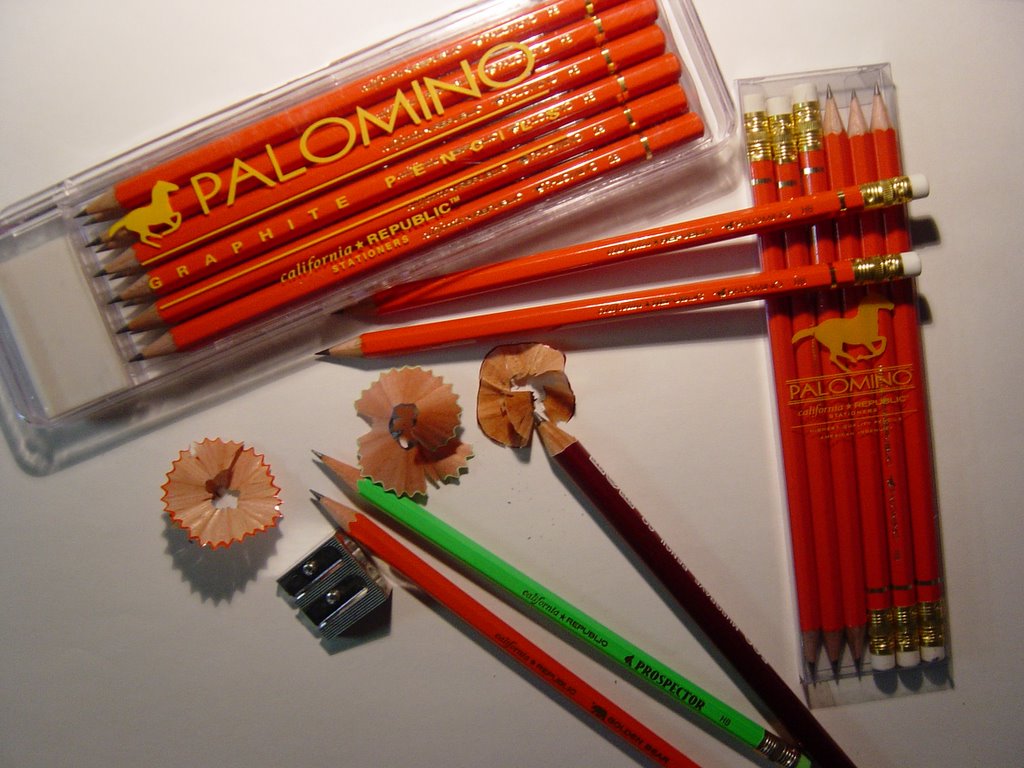
We've been hearing from many of you that while you're having a great time riding those Palominos bareback your comfort would benefit from a bit of additional accessorizing in the tack department. Well, we listened and here are some of our first accessory offerings includes two new unique Palomino items with erasers now available at our Pencil World Creativity Store.

First, our new Eraser Tipped Palomino HB is available initially as a 6 pack similar to our other Palomino items. Next, our new Palomino Deluxe Mixed Grade 12 Pack doubles up on the pencil count in our normal 6 count Mixed grade pack plus adds two new features: a hand held art eraser and our Deluxe hinged plastic case which provides a sturdy permanent stable for those Palominos and new accessories such as a sharpener and eraser. Quantities of both items are somewhat limited in these first offerings on eBay, but we have more replenishment stock on the way which is scheduled for arrival here in the US during March.

We also now have our first KUM sharpener offering at Pencil World, the KUM Metal Wedge Magnesium 2 hole sharpener. This simple classic wedge sharpener offering from KUM provides the option to sharpen both standard and jumbo sized pencils whether round, hexagonal or triangular in shape. This item comes courtesy of a barter arrangement on some GoldenBear pencils with our new trade partner PencilThings.com who has taken on the full line of KUM sharpeners and soon will be adding a selected mix of California Republic pencils as well. During the Frankfurt fair I also met with our new friends from KUM and we have a few additional special sharpener items we will be adding in the coming month or so including some interesting bundled items. Although our KUM sharpener selection will be much more limited than the full range selection now available at PencilThings.com we do think those sharpeners we will carry should complement our pencil range well.

We're always looking at other Palomino breeding opportunities including more interesting tack items to add to our stable of Palominos and other California Republic offerings. While we we can't offer today the breadth of range in tack items you might find here, we promise if you keep riding those Palominos and sharing your experiences with your friends we'll be listening to your ideas and requests and working away at what we think makes sense for the long term.

Thursday, February 02, 2006

Sawadee: Made in Thailand

After a busy week in Frankfurt for the annual PaperWorld show last week I just finished a four day visit to our Thailand pencil facility, Propen, Ltd. and am now in Tokyo. More about the fair and my Japan visit in a later post. Quite a change from snow, below freezing temperatures and the hustle and bustle of Frankfurt to the warm climate of coastal Thailand and the wonderfully pleasant and friendly culture typified by the greeting Sawadee.

Our primary business at Propen is to produce OEM pencils for our customers around the world who need either raw, semi-finished or finished imprinted or decorated pencils packed to their specifications. We also produce our Forest Choice, Golden Bear, Prospector and Spangle pencil ranges in this facility. Our Palomino pencils are produced under subcontracting arrangements in Japan to our specifications and then shipped to Propen where we package and consolidate shipments along with our other products produced in Thailand. Finished product shipments go direct from Propen to our customers around the world or can be transferred to one of our warehouse locations to be shipped out in smaller orders to customers in a given market.

This facility is both Chain of Custody Certified to produce FSC certified wood pencils (such as our ForestChoice brand) and ISO 9000 Certified for quality processes. It's located in a special econmic development zone run by the Thai Board of Investment and is located at the port of Laem Chabang in the Gulf of Thailand. This about a two hour drive from Bangkok when traffic is good and about 20 minutes from the resort town of Pattaya. The advantage of the BOI location is that pencil slats from our Tianjin, China facility and other components from overseas can be shipped by port processed into pencils and reexported free of duty.

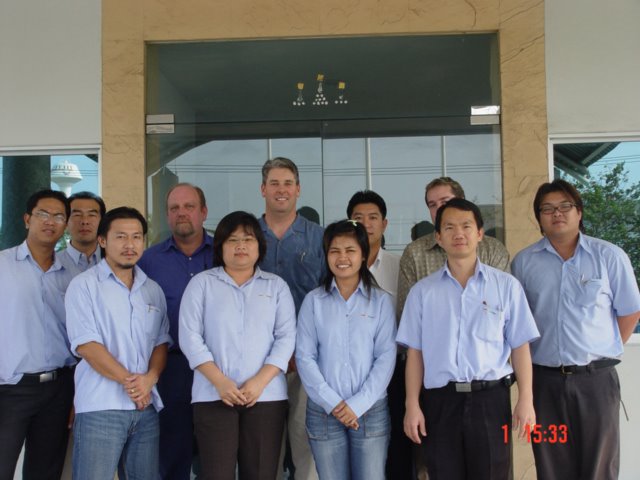
A typical trip for me here includes time on the factory floor, a review of operating and financial performance with the GM, discussion and analysis on details of upcomming orders and business opportunities we are pursuing to assure we have clear action plans and time with the department heads to keep them up to date on developments in the busines and address any communications issues requiring focus to assure we continually improve customer service and response times as our business grows and the complexity of operations and scheduling issues increases. We have a good young team here, growing in capability and experience and it's a pleasure and honor to see their dedication and commitment.

Finally, this trip we also completed a detailed product line review of our California Republic range to address issues of new product additions, discontinuations, product specifications and quality standards, packaging design changes and other enhancements as we look forward to increased focus on generating some initial retail distribution. We performed a short run to add eraser tips to some Palomino Orange HB and will be offering these next week at our Pencil World eBay store along with an exciting new packaging format for a 12 count Mixed Grade Graphite pack which will include a hand held eraser and a KUM sharpener in a nice Palomino plastic hinged container you will love to have to keep those ponies safe and secure on your workspace.

Sunday, January 29, 2006

Moleskine & Palomino

I've been travelling overseas to Frankfurt Paperworld show and now to our pencil factory in Thailand. Too tied up to get down to the detail in writing Part 3 on making a Pencil Revolutionary out of an Environmentalist. There's also some interesting new pencil items I plan to write about from the Paperworld show. All this will need to wait till I get back home though.

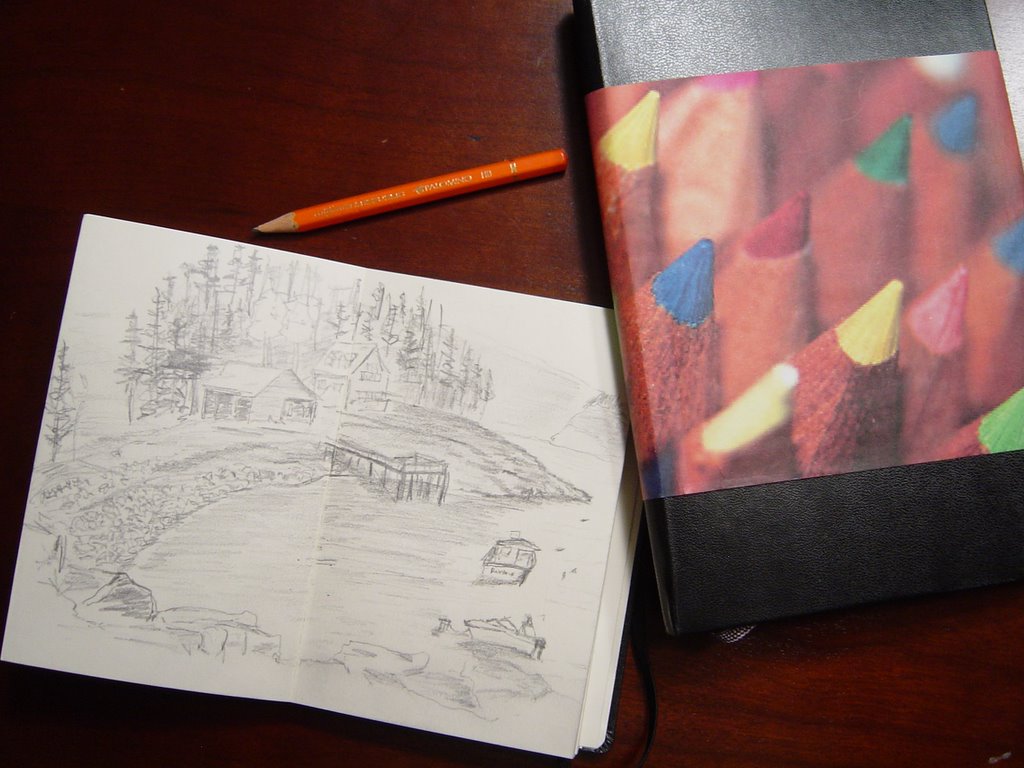
In the meantime I thought I'd treat you to a few of the increasing associations between Moleskine and Palomino I've been finding on blogs, Flickr and the like. Thanks to A.E. Baxter for this first Palomino-Moleskine "glam" shot.

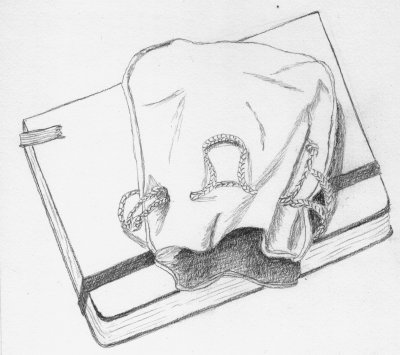
Nita's talent is visible on her InkTracks blog where she drew this Moleskine using her Palomino Pencils. We're glad she digressed from her wonderful color efforts to work in graphite for a few sketches last month. We'd love to see more.

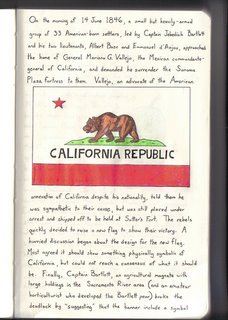
I found this next link just today from The Fountainhead on the Flickr Moleskinerie pool. I don't actually know yet if any of our California Republic color pencils were used in this drawing, but I couldn't resist pointing this out. The pages include an interesting write up on the brief one month history of the republic and the mistaken design of the original flag of the California Republic which was supposed to be a pear, not a bear. Fortunately, we've outlasted our first month unlike our namesake. However the spirit of Captain Bartlett and those original California revolutionaries remains an inspiration for us here at California Republic Stationers. You may have already noticed that we've also encorporated this spirit into our Golden Bear brand which we think works out much better than the Golden Pear would have. Not sure the "Pear revolution" would have lasted even a week back in 1846.

Oh yeah, I've commented recently on the Pencil Revolution, but will mention this here also. Upon return from my current travels in about a week we will be listing on Pencil World Creativity Store our newest item the Palomino graphite HB with eraser which many of you have been asking about. Here's a sneak peak.

Monday, January 16, 2006

Pencils: An Environmental Profile

Or Part 2 in my continuing series on "How to make a Pencil Revolutionary out of an Environmentalist."

In Part 1 of this series I set the stage by indicating my defining parameters to answer the question, “What arguments would one use to convince an environmentalist to use wood cased pencils?” I’ll say in advance please excuse the length of this post as environmentalus rabidus extremus is a wily and cagy creature and so the foundation and evidence for my arguments must be well constructed.

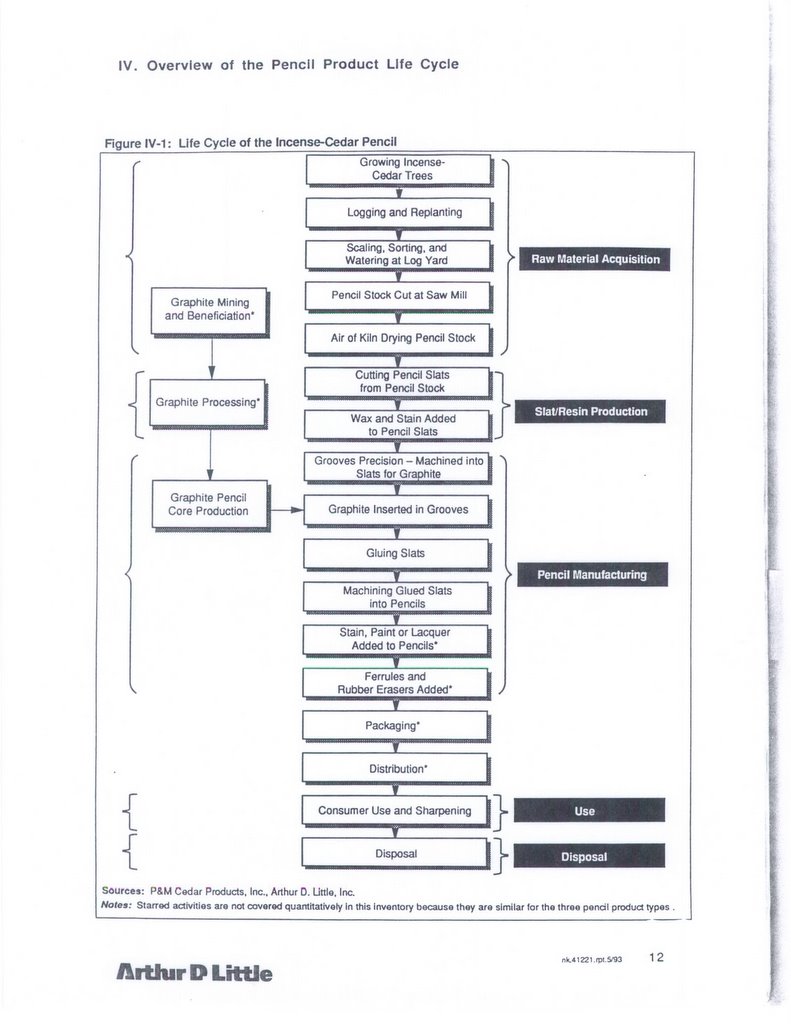
To accomplish this I will today address a range of environmental impacts with results drawn from an independent third party study performed by Arthur D. Little during 1993. This study was performed on behalf of our former Incense-cedar pencil stock supplier and sister company in our family group, P&M Cedar Products, Inc. P&M operated several sawmills cutting cedar logs harvested in California and Oregon forests into pencil stock and other lumber products and was later integrated back into CalCedar. The pencil stock is converted to pencils slats by our company California Cedar Products Co. for distribution to pencil manufactures. This study, entitled “Pencils: An Environmental Profile”, was designed to develop an improved understanding of the environmental related strengths and vulnerabilities of the Incense-cedar pencil as compared to extruded plastic pencils and to pencils with a recycled paper casing. By recycled paper pencils we mean pencils produced from pencil slats made from compressed recycled paper products, such as the Sanford American EcoWriter pencil produced during the 1990s.

This was a quite extensive study which was complicated by the wide range of manufacturing inputs used in each case. The report references over 75 resource materials used in addition to extensive interviews and on-site investigations and discussions with manufacturers involved in various processes involved through the 5 stage lifecycle. Additional experts in areas of plastics and pulp and paper production were also consulted along with in depth data collection that is all summarized in the report running approximately 100 pages.

The environmental analysis focused on evaluating resources consumed and pollutants produced by each of the three pencil casing types during five life cycle stages including:

Raw Material Acquisition – harvesting of timber and production of pencil stock for incense-cedar pencils, oil and natural gas extraction and processing for plastic pencils, and collection and sorting waste paper for recycled paper pencils.

Slat/Resin production – pencil slat production for incense-cedar and recycled pencil production, and plastic resin production for plastic pencils

Pencil Manufacturing – production of pencils from slats for incense-cedar and recycled paper pencils and from plastic resin and wood flour for plastic pencils, including the graphite-plastic extruded core vs. the traditional graphite-clay kiln fired cores used in pencils produced from slats.

Use – consumer use of pencils

Post consumer disposal – disposal of pencil materials, such as pencil shavings and stubs, including landfill and incineration alternatives

The results of the analysis indicated that each of the three pencil products has comparative environmental advantages and disadvantages. On the whole, the incense-cedar wood cased pencil was found to be superior to the other two forms of pencil across a greater number of the dimensions analyzed in terms of reduced impact on the environment. The resource inputs and environmental outputs considered across each life cycle and the key conclusions for each are summarized here:

Environmental Impacts on Resource Inputs
Raw material consumption
– Wood pencils require four times more raw materials than the plastic pencil and more than twice the raw materials of the recycled paper material. However a much higher proportion of raw materials used in wood cased pencils are recyclable and the wood pencil consumes less than half the non-renewable resources as either the plastic or recycled paper pencil.
Water consumption – The wood cased pencil consumes approximately 60% of the water used by plastic pencil and approximately 10% of the water consumed by the paper pencil.
Energy consumption – The wood pencil requires approximately ½ the energy required by the paper pencil and a similar quantity of energy as the plastic pencil. The Incense-cedar wood pencil utilizes significantly more renewable energy sources than the plastic or recycled paper pencil.

Environmental outputs
Atmospheric emissions – The wood pencil results in emissions less than or equal to those of the plastic and paper pencil for carbon dioxide, nitrogen oxide, culfer oxide, and particulate matter. The wood pencil emits from 5 to 6 times more carbon monoxide than either the plastic or paper pencil. The wood pencil emits more than three times the organic pollutants emitted by the paper pencil, but only about 10% those of the plastic pencil.
Waste water effluents – The wood pencil emits insignificant quantities of waste water pollutants; emissions of BOD and suspended solids are greater for plastic and paper pencils.
Solid waste – The wood pencil generates less net process solid waste requiring disposal and less post consumer waste than the other two pencil types. While the wood pencil generates more solid waste a greater proportion of this solid waste is later recycled into various products. (See my prior post “Wood Manufacturing Byproducts” for more on CalCedar’s efforts in this area through the years)
Hazardous waste – The wood pencil generates significantly less hazardous waste than either the plastic or recycled paper pencil.

This report is certainly quite helpful to demonstrate the relative environmental superiority of the wood cased pencil versus the two other pencil types. However an objective, intelligent review from the viewpoint of our target consumer environmentalus rabidus extremus would likely yield the following objections:
- The report does not address impacts of graphite production as well as production of other components common to each of the three pencil types. Nor does it address alternative forms of writing instruments.
- The study is now 12 years old and manufacturing processes and relative environmental impacts may have changed due to various improvements in different industries.
- The report focuses on Incense-cedar as a surrogate for all wood casings. Environmental control standards may not be as high or as consistently enforced in other parts of the world where alternative pencil woods now more commonly used in today’s pencils are grown, harvested and processed into lumber, slats and pencils.
- Finally and probably most importantly to rabidus extremus this report does not address wildlife and ecosystem impacts other than the perspective of raw material and water resource consumption in unit volumes.

While in Part 1 I narrowly defined the convincing to be done as limited to selection among cased pencils, some generalizations might be made about comparisons between plastic writing instruments vs. wood cased based on results of this study. These wood favor wood over plastic. Impacts of common cased-pencil components such as graphite, erasers and ferrules were not analyzed in this study since they would have no relative impact in a comparative analysis. How graphite might compare to the vast array of inks used in pens and how ferrules and erasers compare on environmental impacts to other pen or mechanical pencil components is unclear.

As far as time gone by since completion of this study, my only comment is that all things progress in time and improvement could be expected on all fronts maintaining the relative comparative advantages and disadvantages. As to the implication that other wood casings commonly used may be less environmentally sound than Incense-cedar, this is a complicated matter and perhaps a good subject for a future post. In the meantime, all the more reason to purchase genuine Incense-cedar pencils.

On the relative wildlife and ecosystem impacts across the raw material sourcing component it’s correct that this report doesn’t seem to assess this dimension. When it comes to timber harvesting the report does makes note of existing protections under the strong forest practice laws in California and Oregon and indicates the mixed use of selective vs. clear cutting harvest practices according to site specifics. So while I’ve clearly made a cogent argument for the wood cased pencil’s environmental superiority on many dimensions that comunus citizenus may very well accept, it appears I haven’t quite convinced rabidus extremus of this and there is yet work to be done.

As chance would have it I recently received a phone call from a real activist, environmentalist type who had questions about cedar use in pencils. So for Part 3 of this series I’ll go right to the source of our target consumer to get to the bottom of his thinking and make my final effort at conversion of rabidus extremus to Pencil Revolutionary.

Friday, January 13, 2006

Paint that Palomino


Vibrant colors and more variety in selecting your own personal mix of Palominos are our theme today for new listings at Pencil World Creativity Store.

First, some of you have been requesting other color lacquers for our Palomino graphite pencils after seeing the beautiful array of colors in our Artist Color and Aquarelle Pencil. While our Palomino orange is our standard we do have a blue Palomino we’re now making available in a 6 pack.

Next, based upon a number of requests we have received sufficient stock on hand here in California to support adding our new Palomino Graphite Variety Pack. This 6 pack allows you to choose any mix of our Palomino graphite pencils from 2H to 2B including the HB in blue or orange according to your own taste.

As a number of fellow Revolutionaries have shown interest in alternate package options for color pencil range, we are introducing the Palomino Artist Color Pencil Variety Pack and the Palomino Aquarelle Pencil Variety Pack. These new items give you the ability to select your own 6 pencil mix from the 24 color range in each line as a means of personalizing your collection to your individual tastes and preferences. You can now replenish your supply for your full wood box sets at a discount or perhaps this will allow you to sample the color and aquarelle ranges at a good introductory price. We're convinced you'll love our color range and will be looking to add one of our wood box sets to stable your Palominos.

As a final color flash for the week, celebrate in red, white and blue with our Spangle Stars and Stripes 40 count tube.

Finally, for those of you looking to stock up on good quality general writing pencils we’re running a special promotion through February 15th in which you can get a free Golden Bear Mini Sharpener with purchase of any four 40 count tubes in Golden Bear, Prospector and now go ahead and add the Spangle Stars and Stripes pencils to that group.

Been looking for Part 2 on my new series, How to Make a Pencil Revolutionary out of an Environmentalist? It’s coming as soon as I can get to it over the weekend. I hope you'll be riding and painting with those Palominos in the meantime.

Friday, January 06, 2006

How to make a Pencil Revolutionary out of an Environmentalist: Part I


Recently John at PRevo forwarded a question from a fellow Pencil Revolutionary that he felt might better be answered by me. The question: “What arguments would one use to convince an environmentalist to use wood cased pencils?”

Initially, I couldn’t resist offering a quick, sarcastic and typically glib “industry think” response by questioning the lack of common sense in the decision making skills of the stereotypical environmentalist. Who can’t see that the use of a well managed, renewable resource is favored over writing instrument casings from alternate materials derived from petroleum based plastics or metallic compounds which involve mining? This of course assumes the Environmentalist chooses to use a hand held writing instrument as opposed to some alternate method of recording and communicating information. This would complicate comparing environmental trade-offs so for the purposes of simplification I’ll assume we’re discussing choosing among alternative writing instruments.

I’ll also overlook the implication in the question that papermaking seems not to be an offensive use of trees (since you have to write on something) while somehow use of a wood cased pencil may be perceived more damaging by some. Given the amount of paper consumption generated by legal proceedings driven by environmentalist appeals of timber harvest plans this is probably a reasonable simplification of the matter.

Of added concern before answering such a question is to define the context of what an environmentalist is, since I need to know who it is I’m trying to convince. Are we referring to the environmentalus rabidus extremus subspecies who views timber harvesting as an affront to all forms of life on earth. For example, someone who might also be a member of PETA an organization that is now even attacking fishing as an activity that causes pain to fish.

Or instead are we more concerned with the evironmnetalus commonus citizenus subspecies. Here we see less on an activist, one who simply wants to be sure their consumption decisions are not overly harmful to the environment. Someone who might purchase a small car or a hybrid SUV over a Hummer or be concerned about forest practices so that the water quality supports fish and other habitat and has no objection to and may even participate in fishing or hunting activity.

For a little help I went to Merriam-Webster for the following clarification.

en·vi·ron·men·tal·ist 1 : an advocate of environmentalism2 : one concerned about environmental quality especially of the human environment with respect to the control of pollution
en·vi·ron·men·tal·ism
: advocacy of the preservation or improvement of the natural environment; especially : the movement to control pollution

This definition seems fairly benign and can be generalized to imply that just about anyone with a concern for environmental preservation is an environmentalist. However given the use of activist word of advocacy and I’m up for the tougher challenge I’ll try to go from the standpoint that we’re dealing with the rabidus extremus variety. Now that this is all worked out, I’ll start building my case.

More to come later in Part 2

Thursday, December 22, 2005

WoodChuck on Fishing


Well I’ve finally got most of the year end work out I brought on vacation of the way. The tree hunt was successful and the Christmas tree is now decorated. So it’s time for the real vacation to begin. And time for the real fun, salt water fly-fishing in Little St. Simons Island creeks and rivers. Love those Redfish and Spotted Sea Trout. Just spending the day out on the creeks, trudging the marshes, catching fish with friends and family has a refreshing effect on your outlook after a long, arduous year. A couple of day’s back we had a wonderful afternoon on Mosquito Creek at what we affectionately call “The Honey Hole”. Five of us must have caught forty or fifty fish in a couple of hours. What’s really surprising is that we didn’t even keep one fish to cook up for dinner or fry for breakfast we were having such a good time catching and releasing them all back to the creek.

To get set in the right mind for our angling this holiday I began reading “Hemingway on Fishing” a few nights back. The book features a selection of excerpts from some of his short stories, novels and journalistic pieces that demonstrate Hemingway’s deep love and understanding of the fisherman’s experience. And a consummate fisherman he was in addition to his writing talent. I myself have never been accused of writing simple prose. I’m generally, the king of the run-on sentence. But Hemingway inspires so I thought I’d add a small bit to the Timberlines on fishing Little St. Simons.

Of course a fisherman can’t go anywhere with out his essential tools and this year I’ve added a few new ones to my kit. Yes, that’s my pocket Moleskine, my Palomino HB and even a KUM sharpener which I rigged to a lanyard along with my other essentials. Yep, I’m now the envy of outdoor artists with that sharpener ever at hand. Slides right into my vest pocket along with pencil and sketchbook. That Palomino won’t go dull when I record my thoughts or capture a quick image when I catch a 5 minute break from the action in the water.

I even got a couple quick sketches in today. The first is of my dad driving the boat out the Hampton River. The wind was up a bit so it was tough sketching while bouncing along the river at 30 mph. Perhaps this should become a new artistic training activity, Extreme Bump Speed Sketching. It can complement Blind Contour Drawing for building your skills. We didn’t catch any fish before lunch, although we did have a Bottlenose Dolphin surface about 5 feet from the boat. I’ll bet he got some lunch at our expense. It was nice just the two of us though, must savor these moments. Don’t get enough opportunities to spend quality time with dad.

The second sketch was drawn while fishing deep in Sancho Panza Creek after our beach picnic lunch back on the island. There’s another literary reference for any Quixote fans out there. “Sanko” as we call it, is just a small creek at this point in the high marsh bounded by saltwort and small clumps of Spartina grass. The fish ride the incoming and outgoing tides following the baitfish, shrimp, mud minnows or whatever the hors d’oeuvres du jour may be. I hoped today’s treat would do the trick, my “Nix Epoxy Fly” with white and green flashing and beaded red eyes.

We were a bit early for the tide turning back out to sea. After an hour of no activity we gave up the ghost on a slow fishing day, crossed the marsh to the Middle Woods Trail and walked the mile or so back to the Hunting lodge through the mixed pine and oak maritime forest. We came across a buck and doe that bounded out of sight into a large clump of Palmettos that provide good cover in these forests. It was a nice walk and a relaxing time with my father. Then his cell phone beeped.

As luck would have it thirty minutes after we left our fishing this afternoon my brother and his father-in-law arrived to the same spot on Sancho and caught nine or ten fish in about 30 minutes time.
Note: For any fishing or Christmas tree fans I’ll be positing some additional photos on my Flickr site in next day or so. Hope your all having a great holiday.

Sunday, December 18, 2005

Have a Very Cedar Christmas


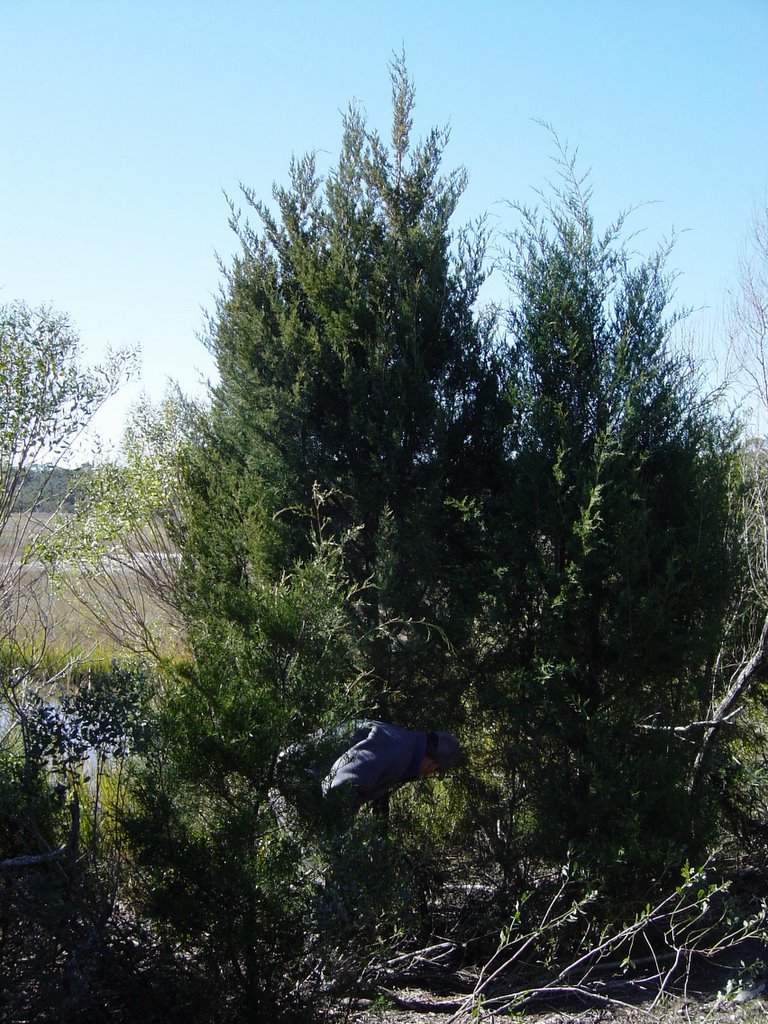
Well here we are again on Little St. Simons Island, Georgia for the holidays. A yearly tradition and sojourn for family Berolzheimer. In another day or two the remaining family members will arrive and well set off for our annual Christmas Tree hunt. I call it a hunt as that’s just what it takes to find a suitable holiday tree on Little St. Simons. No plastic Chinese produced tree or perfectly proportioned fir from the Christmas tree lot for us. Always a naturally grown Southern Redcedar, cut fresh from our own property.

Now a cedar, or more properly in this case a juniper, is not your typical Christmas tree. More a bush than a tree in this coastal barrier island environment, the Southern Red Cedar is not the prototype ornament hanger with its scrappy, lightweight branches. A one hour pickup truck ride and hike, bundled up against the cold, looking for something resembling the traditional conical shape, stopping here and there, inspecting possibilities, casting our votes, lobbying amongst one another for which tree will work best for us this year. The most well proportioned trees we find are always too big even for our central high ceiling location. The smaller ones tend to have some natural defect from growing too close together or up against a prickly pear or Myrtle bush, only discovered upon closer inspection. Finally, we choose and cut, always a compromise from the ideal. A picnic lunch follows and the late afternoon and evening are spent propping up the tree, hanging lights and ornaments even wiring it to the wall so the excessive ornament weight doesn’t tumble the tree to the floor. The result though not the mainstream “perfect tree” is our own form of perfection.

Often we consider whether we might simply take a half acre or so to plant and properly manage a number of trees including more suitable Christmas tree species so we can have better trees in future years. Of course the cedar tradition is in our blood as a family and here at Little St. Simons Island. Originally the property was purchased by the Eagle Pencil Company (LSSI Timeline see 1908) to harvest the taller commercial size Southern Redcedars (Juniperus Virgniana subspec Silicicola)for pencil wood supply back in the days when it’s cousin the Eastern Redcedar, Juniperus Virginiana, was the preferred species by pencil manufacturers. However growing conditions for commercial size Cedars were not ideal and the economics of harvesting on and transporting from an island proved. Instead the property has become a family retreat and now can also be your private Island hideaway.

While we have not chosen to become Christmas tree farmers over 21,000 other owners have nationwide. A little research at the National Christmas Tree Association website yields some of the following interesting facts:

- There are from 500,000 acres of commercial Christmas tree farms in the United States which sell from 25-30 million trees each year.
- The most common species are balsam fir, Douglas fir, Fraser fir, noble fir, Scotch pine, Virginia pine, and white pine.
- Every acre of Christmas Trees grown produces the daily oxygen requirement for 18 people.
- Beyond being a renewable resource increasing number of real Christmas trees are recycled each year. Find a recycling program here.
- The average artificial Christmas tree of which China produces 80%, are used for 6-9 years before ending up in a landfill, though I suppose there may be some recycling opportunities growing for these imitators.
- A Real Tree is five time more environmentally compatible than a plastic tree, according to this study by Swedish researchers.


So good luck with your Christmas Tree hunt this year if it’s still to come. Choose wisely and if you can try a cedar or at least a few Palominos, Forest Choice of Golden Bears under the tree if the real thing is not an option. Most importantly enjoy a wonderful and joyous holiday season

Friday, December 09, 2005

SwarmSketch: Collective sketching of the collective consciousness


It's not pencil, but an interesting experience in group collaboration or tug of war depending upon your perspective.

So if you haven't got the patience today to work on your own pencil drawing here's a change to contribute just one line to the daily Swarmsketch drawing along with hundreds of others. Then you vote on the darkness of a number of lines to help influence the direction the drawing is taking.

There's a new drawing with a different theme every day. You come back the next day and see the final result. I helped draw the right shoe of this wheel chair bound rocker in the drawing titled "Rock & Roll Hall of Fame". You may not like the end result, kind of a tug of war

Saturday, December 03, 2005

Who's got that Palomino?


It's been fun to learn about the growing list of Palomino fans. What a diverse and interesting group of people we are. Clearly we all have a common interest in pencils and in my view PRevo has done a wonderful thing bringing us together. But it's clear there are many more links than an interest in pencils and the outlet to wax philosophic about our chosen tools of choice, how we use them and what might be done to improve them.

Appreciation of a finely crafted product is clearly a common denominator. Whether it's a Palomino, a Moleskine sketchbook, a Ticonderoga, a Faber-Castell Grip 2001, or whatever. Though it's clearly deeper than a simple appreciation of quality. An emotional connection gained from use of these items and how we feel about ourselves when we're engaged in that activity.

Certainly there is the sense of community. But there are thousands of on line communities and I would assume that many who have joined the Pencil Revolution are active in other communities as well. As a group I've found beyond pencils we do have other common interests such as bird watching and photography, reading, drawing, etc.

For me creativity is the strongest and most common link. Whether it's writing a 50,000 word novel in a month in pencil, exploring and designing unique symbology, or simply keeping our own blogs about a broad and diverse group of subjects. In fact it's the link as a creative outlet that inspired me to get going with Timberlines and begin to offer Palomino pencils on eBay where perhaps I have helped a few others with the tools to. Since then I've even taken up notetaking, writing and drawing in a Moleskine myself when I haven't drawn in a number of years. And I'm not the only one.

Finally, a very special congratulations to Cyberlizard. I see you are a winner in 2005 National Novel Writing Month contest and we worship you for writing the whole thing in pencils and using Palomino pencils at that. For the sake of our eBay store we're kind of hoping you'll just keep on going month after month. Can't wait to learn more about your novel.

Pencil World Promotional Note: We've now added aquarelle pencils to our Palomino range and have great offer going on for Christmas pencil stocking stuffer bonus giveaways with a purchase of any of our Palomino pencils.